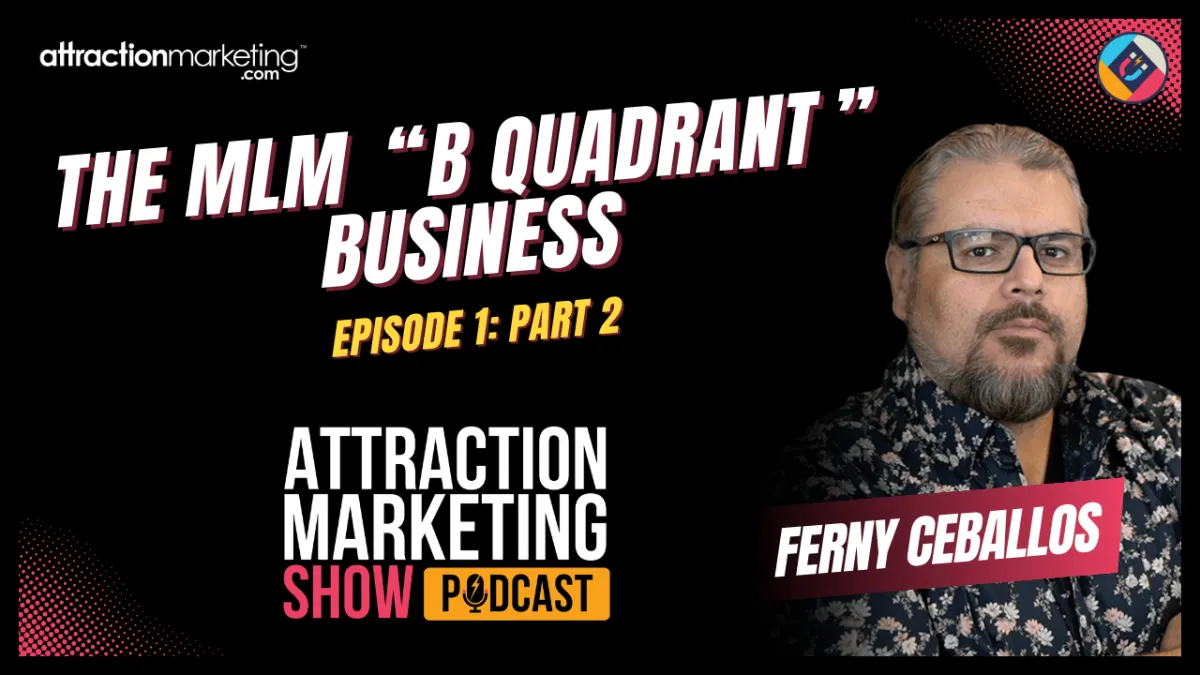
"B Quadrant" MLM Business That Survives Company Shutdowns | Episode, Part 2
Season 1, Episode 1, Part 2 | The Attraction Marketing Show
In Part 1, Ferny Ceballos walked us through the full origin story — the MIT engineering degree, the meeting he got tricked into, nine months of failing the traditional way, discovering Magnetic Sponsoring, and ultimately becoming co-founder of the very company he once joined as a broke, desperate student.
Part 2 is where it gets real.
JT DeBolt steers the conversation toward the present — what the industry is actually facing right now, what separates the people who build something lasting from those who stay stuck, and the surprisingly honest takes Ferny has on network marketing's biggest problems and its biggest opportunity.
The Power of Skill Development — and What People Really Come Here For
JT opens Part 2 with an observation that's easy to miss when you're in the middle of it.
AttractionMarketing.com has been around for a quarter of a century — if you count the full lineage back through Magnetic Sponsoring. And what keeps it growing isn't just the tactics it teaches. It's what happens to people when they're inside the environment.
"They come in wanting to make money. Then they start to realize the power of skill development. The power of personal development. What it actually means to run a business."
That shift — from "I want grocery money" to "I want to build something that matters" — is where real results start to compound. And the people who make that shift, JT points out, are the ones with Ferny's fingerprints all over their success.
Ferny's response is grounding. He's quick to redirect the credit.
"We're a component of their success. We provide the environment, the knowledge, the mentoring, the direct feedback. But they still have to do the work. They're the CEO. We're not."
Your Business Doesn't Care How You Feel Today
This is one of the sharpest moments of the entire episode.
Ferny leans into something most coaches won't say directly: your business is not empathetic. Your profit and loss statement doesn't care that you're having a hard week. Your team's momentum doesn't pause for family drama. Your income doesn't hold while you wait for a better season.
"Your business does not care that your mom got cancer. It only rewards you based on what you give it."
He's not being cold. He's being honest about something that derails more people than any tactic or strategy ever could — the habit of treating the business as optional until conditions are right.
His challenge to anyone in network marketing: If your business was already generating a million-dollar income, how would you treat it? Would you cancel the work session? Would you not tell your family it was a priority? Would you let a bad week become a bad month?
Of course not. So why treat it that way now?
"You're treating it as something that is not yet a seven-figure business. Therefore it won't become one. You have to show up as if it's already that — and prioritize it the same way you would your career."
And on the passive income dream — the idea that once you build it, you can walk away and collect checks forever — Ferny is direct: that's not how it works. Not in network marketing. Not in any business.
Leverage is real. Freedom is real. Working less is real. But you're still the CEO, and the business still needs you to show up. The goal isn't to stop working. It's to get to a place where the work is on your terms.
The Biggest Risk in Network Marketing Nobody Talks About
Ferny shifts into something that hits differently if you've been building for a few years: network marketing companies are not guaranteed.
Over the past few years, companies have shut down overnight, canceled MLM comp plans in favor of affiliate models, or fired entire distributor bases without warning. Years of work, gone.
And in almost every case, the people who got devastated by it had built everything inside someone else's house. No email list. No personal brand. No audience they actually owned.
"The company is a vendor. If that vendor goes out of business, you find another one. Your business doesn't collapse — you just swap out a supplier."
This is a core teaching at AttractionMarketing.com that goes back to the very beginning: build assets you own. Your email list. Your SMS list. Your social following. Your brand equity. These don't belong to the company. They belong to you.
And because of that, every AttractionMarketing.com student who's been through a company shutdown has been able to rebuild. In most cases, bigger than before.
Ferny puts it plainly: you can love your company. You just can't trust it with everything you've built. Not unless they're giving you full access to their financials — which almost no privately-held network marketing company does.
Network Marketing Isn't a Scam — But It's Earned Its Reputation
One of the most honest exchanges of the episode comes when JT asks Ferny to draw the line between what's actually illegal, what's just unethical, and what's simply a business that didn't work out for someone.
Ferny's take: the detractors of network marketing make a lot of valid points. The industry has earned much of the negative reputation it carries — through deceptive recruiting tactics, misleading income claims, and a culture that tells people they don't need skills while quietly doing a ton of personal development work.
"Network marketing's reputation is a hundred percent network marketing's fault. No one else's."
But that's not the same as the industry being illegal. Specific practices can be illegal. Specific companies can be structured illegally. But the model itself? Ferny is clear: it remains one of the most accessible on-ramps to entrepreneurship that exists for the average person.
"Where else can someone with zero business background, no special skills, no capital — enter a profession that teaches them real marketing, sales, and leadership skills while they're implementing them? There's no equivalent."
The cringe tactics he describes — tricking people into meetings, hiding what you're selling, the "get to who get to who" mentality — aren't just ineffective. They're the reason so many people have a bad taste in their mouth about the industry. And they're exactly what attraction marketing exists to replace.
The First Move for Anyone Building Online
JT asks the question that matters most for most people listening: if someone is brand new to building online — or has been in network marketing for a while but never tried the digital approach — where should they start?
Ferny's answer is the same answer that's been at the heart of everything he's built:
"Don't go at it alone. Find a mentor who has not only done what you want to do, but has a track record of helping other people do it too."
And he's specific about what to look for. A lot of successful network marketing leaders are terrible coaches. Success at building a team doesn't automatically translate into the ability to help someone else build one.
Look for evidence. How many people have they helped? What are those people's stories? Is there a structured curriculum? When do you get actual feedback — not just content to consume?
He also addresses the objection he hears constantly: "But have they helped anyone in my company?" His response: that almost never matters. The principles of building a business online are the same regardless of what you're selling. What matters is whether the mentor has results — and a track record of creating them in others.
What Ferny Predicts for the Next Decade
Asked to look ahead, Ferny is careful. He has some sharp things to say about gurus who make bold predictions with unfounded certainty — "that tells you more about their need to feel certain than it does about the prediction itself" — but he does offer what he sees as most likely:
The industry will have to evolve. It already is.
"Younger people entering network marketing are not going to home meetings. They're building on TikTok and Instagram. The companies that adapt will thrive. The ones that don't will slowly contract and die."
He points to Jennifer Glacken, a leader in one of the oldest network marketing companies in existence, who has now transitioned over 60% of her team from building entirely offline to building online. Companies that encourage that kind of evolution will pull ahead. Companies still fighting the internet — after 25 years — are choosing their own decline.
Rapid Fire: Books, Myths, and the Cringe Stories
The episode wraps with a rapid-fire round that's worth sticking around for.
On books: Ferny recommends three. The War of Art for anyone dealing with resistance and procrastination. The Subtle Art of Not Giving a F*ck by Mark Manson — "if you can get past the title, it's genuinely useful." And Mach 2 With Your Hair on Fire by Richard Bliss Brooke for anyone trying to make the mental leap from where they are to the vision they're working toward.
"You can't work on your mindset from the inside out. You have to work on it from the outside in. Your actions need to be consistent with someone who is successful — and then the mindset follows."
On the one myth he'd erase from the industry forever:
"It's not selling, it's sharing." Sharing is not a skill. Selling is a skill. Marketing is a skill. There are only two ways to build a network marketing business — get really good at sales, or get really good at marketing. That's it.
On cringe tactics: Ferny's personal entry is memorable. A mentor told him from stage that if the person you're dating isn't fully on board with your business, you should let them go. On the second date with someone he'd just started seeing, Ferny pitched the business. There was no third date. She ghosted him. He laughs about it now.
JT's cringe story is something else entirely. Starving and broke, he was reverse-prospected into an MLM meeting at a Golden Corral. He sat down with his back to the room, a guy in a suit closed a sliding partition behind him, and every single person at every other table had been pre-planted. He got a free meal. The guy didn't sign up. He has never willingly entered a Golden Corral since.
The One Thing That Needs to Change
When asked what he'd change about network marketing if he could change one thing, Ferny comes back to the same idea that runs through the entire episode:
"Set the right expectation from the start. This is a profession. It requires skill. If you want six figures or seven figures, the laws of business say you need to earn it. Tell people that upfront — and watch the whole thing change."
The problem isn't the model. The problem is the sales pitch that gets people in. The idea that no skills are required, that sharing is enough, that "just get to who get to who" and you'll be rich. That's what poisons the well for everyone — and it's what attraction marketing, done right, exists to fix.
Network marketing, Ferny says, is still the single best on-ramp to entrepreneurship available to the average person. There's nothing else like it. But it only delivers on that promise if the people inside it are honest about what it actually takes.
─────────────────────────────────
Ready to Put This Into Practice? Here's Your Next Step.
This episode was made for network marketers who know there's a better way to build — and are ready to find it.
The Digital Recruiting Bootcamp is a free step-by-step training on how to attract qualified prospects online, enroll with confidence, and build a team that actually duplicates.
No cold messaging. No home parties. No cringe.
👉 Click here to get free access and get started today.
─────────────────────────────────
And if you haven't subscribed to The Attraction Marketing Show yet, now's the time.
New episodes drop every week —real conversations with the people who built this movement.