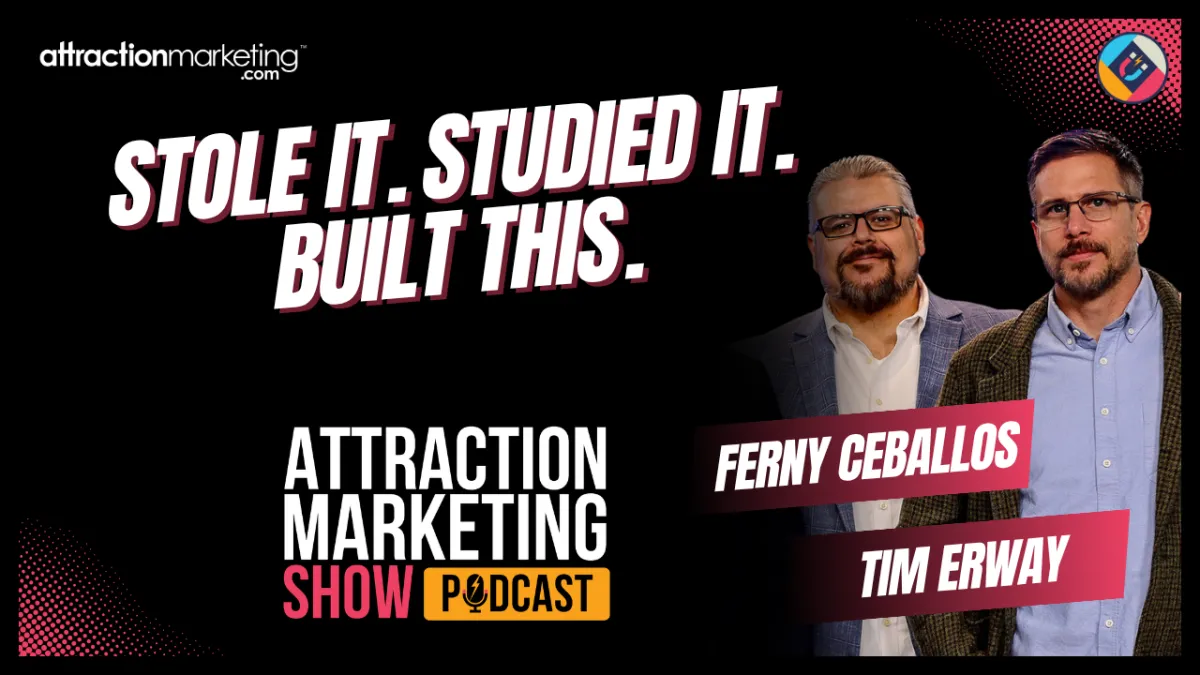
Ferny & Tim: The Bootleg Course That Started a Movement | Episode 10
Episode 10 | The Attraction Marketing Show
The origin story of AttractionMarketing.com has been told in pieces across multiple episodes of this show.
Tim told his version in Episode 2. Ferny told his in Episode 1. But Episode 10 is the first time they've been in the same room together — on the same show, trading stories, filling in each other's gaps, and occasionally disputing whose version is more accurate.
Recorded live in North Carolina during Digital Networker Live, host JT DeBolt sits down with both co-founders for what turns into one of the most entertaining and instructive conversations in the show's run. They cover how Ferny bootlegged Tim's course, how Tim discovered Ferny by accident when Ferny ended up on his email list, how a bonus workshop offer turned into a thousand-person event at the Venetian in two months, and why the movement they built was never supposed to be this big.
If you want to understand what AttractionMarketing.com actually is — where it came from, what's driving it, and what the people behind it genuinely believe — this is the episode.
How a Spiral-Bound Kinko's Book Started Everything
The chain of events that eventually led to AttractionMarketing.com begins with Tim Erway getting a phone call from a stranger who'd seen his name in a magazine.
That stranger was Mike Dillard, who had written a book — printed at Kinko's, spiral-bound, mailed one by one from his house — that was selling twenty-five copies a day. Mike needed a fulfillment solution. Tim connected him with one. A collaboration was born.
They launched a product called MLM Traffic Formula — a teleseminar-based course on search engine optimization, paid ads, and digital marketing for network marketers. It did over a million dollars in sales. One of the customers was Ferny Ceballos.
But Ferny didn't exactly buy it straight.
"I have a confession. I bootlegged it. Someone from Texas asked if I wanted to go halfers — one of us buys the course and makes a copy for the other. She never did anything with it. But I studied that thing like it was my religion."
The course arrived on CDs. Grainy recordings of teleseminars. A workbook Ferny annotated. He went through all of it — funnels, copywriting, SEO — and that became the technical foundation of everything he would later build.
Karma, he notes, has a way of coming back around. The money he saved bootlegging that course he spent many times over on other courses across the digital marketing world. He became an information junkie. And the knowledge he accumulated — even before he was implementing it — made him one of the most knowledgeable people in the community when Tim and Mike eventually launched their social network.
The Community That Ran Like TikTok in 2008
Tim and Mike built one of the earliest niche social networks on the internet — an online community specifically for network marketers learning digital strategies, built before Facebook had become what it is today.
Ferny showed up and gave everything away for free.
Articles. Strategies. Answers to questions in forums. Everything he'd learned from the courses, everything he'd implemented, everything he was figuring out in real time — he shared without restriction. No pitch. No ask. Just value.
"The platform worked kind of like TikTok today. When you published something it would show up on the front page. If enough people interacted with it, it would move to featured content. And at the end of every article there was a call to action to opt in to my list. So I was generating leads for free from that community the whole time."
When Mike started paying attention to how good Ferny's content was, his reaction was simple: dude, you should be charging for this. They got on a call. They started talking about doing a live event together.
That conversation set the chain in motion that led to No Excuses Summit — the industry's first major live event specifically focused on online and attraction marketing strategies — and ultimately to the partnership that became AttractionMarketing.com.
Two Origins. One Movement.
What makes this episode genuinely interesting is hearing both Tim and Ferny describe their own starting points in the same conversation — because they couldn't be more different.
Ferny: straight-A student, MIT engineering degree, aerospace industry job, graduate school at USC, introduced to network marketing through a business meeting he thought was a tech startup. Spent years consuming information obsessively before finding the courage to implement. Needed mentorship not for answers but for validation — someone to say keep going.
Tim: high school dropout, kicked out of regular school, continuation school, quit at seventeen, joined Amway with his mother co-signing the application. First instinct was always to act, scratch the paint, ding the sheet metal, figure it out by doing. Driven entirely by a need to prove he wasn't a loser.
"My driving force was literally to prove to myself and to prove to other people that I wasn't a loser. After failing at everything, I made a decision: I'm not gonna behave like a loser anymore. I'm gonna at least pretend like I'm not. And it was almost surreal when it started to work."
Ferny's counterpart:
"I was the straight-A student. I studied everything I could. My problem was I wasn't taking action. Something would always stop me — am I doing this right? Is this the right direction? What if this doesn't work? The second-guessing that slows you down and eventually you stop altogether. It wasn't until I got close to mentors where that went away."
Two completely opposite personalities. Two completely different paths to the same destination. And the thing that connected them was a philosophy: digital marketing, done ethically, with real value, builds something nobody can take away from you.
That's the foundation the whole company rests on. Not a person. Not a tactic. A belief.
The Imposter Who Made It — And the Overachiever Who Got Stuck
One of the most honest stretches of this episode is when Tim and Ferny separately describe the imposter syndrome they each carried for years — from very different directions.
Tim built his business feeling like a hack. Like the other shoe was about to drop. Like he was pretending to be a business owner and sooner or later someone would figure it out. The success was real. The feeling of illegitimacy persisted anyway.
Ferny's version was different but equally real. The world he came from didn't recognize what he was doing as legitimate. His MIT friends were hostile about network marketing — not just skeptical, openly adversarial, the kind of intellectual sparring designed to make you abandon whatever position you're defending.
"I was free of my job. It was working. I was making money. And we're out with some friends having beers and this guy just wouldn't let up about network marketing. At that point I believed so much in this that I basically told him if you want to keep talking about it, I'll kick your ass. Let's go outside."
He backed down. The conversation ended. Ferny kept building.
The lesson they both draw is the same: belief has to come before proof. You cannot wait for external validation to decide whether what you're doing is legitimate. By the time the proof arrives, the people who quit will have already been gone for years.
From Underachiever to MIT — The Two Paths to the Same Place
JT presses both of them on this: given the radically different backgrounds, what's the character trait that actually produced the results?
Tim's answer is immediate: the willingness to fail forward. To scratch the paint. To act before knowing. The exact opposite of what school systems teach — where you learn everything about a subject before ever applying it.
Ferny's answer is also immediate: the ability to come prepared to every mentorship interaction. To show the work. To arrive at every call with notes, examples, and a clear articulation of where he was stuck — not just a question.
"If you're going to show up at a mentor's office hours, you come prepared. Here's what I'm working on. Here's what I tried. Here's where I'm stuck. They're not going to do it for you. They'll give accurate feedback if you give them accurate information. If you come half-assed, you leave with half-assed guidance."
Both approaches worked because both people were committed to using the mentorship rather than waiting for the mentorship to solve their problems.
The biggest failure mode Tim identifies in students: coming to a mentor expecting to be handed the answer. The most successful students — a small minority — take the answer, say got it, and run. They implement. They come back with results and new problems.
The larger group comes back with more questions. They want every uncertainty resolved before they move. And Tim couldn't help those people for years — until he learned a different kind of coaching.
Teaching People to Fish — The Dunkley Method
The shift in how Tim coaches — and by extension, how AttractionMarketing.com teaches — came from Blair and Melissa Dunkley, mentors who specialized in coaching coaches.
The insight: the small percentage of students who succeed when you tell them what to do are already effective problem solvers. They're not emotional about the process. They hear the answer, they implement, they course correct.
The majority aren't there yet. And telling them what to do doesn't build the capacity to think on their own.
"The harder and more challenging thing to do is to help people solve the problem themselves. But that's the most empowering long term. You ask them the questions you would ask yourself in that situation. Their brain can't generate those questions yet — you ask them on their behalf. Eventually their brain picks up the pattern and they start asking themselves."
This is why AttractionMarketing.com's mentorship culture feels different from most training programs. It's not designed to give you everything. It's designed to make you resourceful — to build the problem-solving pattern in you so you can run without needing someone to hold the flashlight.
Ferny adds his own reflection on this: the thing that most distinguished his best mentors wasn't the information they gave him. It was the permission they gave him to simplify and commit. To stop the second-guessing. To pick a direction and go.
"When I had regular check-ins, the second-guessing went away. Not because they told me I was doing it right — because I was checking in with someone. That alone caused me to accelerate and become more aggressive about implementing. Validation was the key, not information."
The No Excuses Summit — From Bonus Workshop to the Venetian in Two Months
The story of how the No Excuses Summit happened is one of the best case studies in this episode — and one of the best arguments for moving before you're ready.
Ferny was competing in an affiliate contest for the second version of MLM Traffic Formula. His team offered a bonus: a live workshop in Vegas for everyone who bought through their link. They had no room booked. No date set. No plan.
They figured they'd get a couple dozen people. They'd sort out the details later.
"We projected maybe a couple dozen people at the workshop. We booked nothing. We're like — yeah, we'll figure out the details. What could possibly go wrong?"
When the affiliate contest ended and it was time to fulfill the bonus, they started asking around about venues and speakers. People kept asking if they could speak. The event kept growing. They ended up contracting the Venetian in Las Vegas, signing a deal that put them on the hook for hundreds of room nights — owing multiple six figures to a billion-dollar hotel company if they couldn't fill them.
"I'm glad my rational mind wasn't working because I probably would've talked myself out of it. We signed the deal. The next week we launched a webinar with Mike and a bunch of other speakers. That first night we sold something like 500 tickets. We ended up doing an event for a thousand people."
From idea to event: two months.
What made No Excuses Summit different from every other network marketing event at the time wasn't the size or the venue. It was the rule Ferny imposed: no pitching from stage. Every speaker had to bring their best teaching and share what was working. No extraction. Pure value.
The model was the message.
"Every other event had professional pitchers competing for the same finite amount of money in the audience. We did the opposite — a value fest. People came away with real knowledge. That's what made it different. And it turned out that if you give people enough value, they want more. And then you can offer them more."
No Excuses Summit ran for ten years. Ray Higdon got his start there. Hundreds of leaders in the network marketing space went through those rooms.
The event eventually evolved into what Digital Networker Live is today — smaller, higher-impact, more focused on implementation. The hype-fest model is fading. The value model is what lasts.
What They Both Believe — After Everything
Near the end of the episode, JT asks both of them what they think created the mentorship culture at AttractionMarketing.com — because both men came from difficult backgrounds, and it would have been easy to replicate what they experienced rather than build something different.
Tim's answer is about contrast. Knowing what you don't want is just as powerful as knowing what you do want. He didn't set out to build a nurturing company. He set out to not build the opposite of one.
Ferny's answer is about a specific moment. Early in JT's time at the company, at a virtual event, Ferny said something from stage that JT has carried with him since.
"We're here to help you become great entrepreneurs. But more than that, we want you to be excellent human beings."
That's the thing that makes the company different. Not the funnels. Not the training programs. Not the technology or the events or the courses.
The belief that building a business is inseparable from building a person. That the skills you develop here — clarity of thought, willingness to act before certainty, ability to communicate, problem-solving under pressure — those don't stay in your business. They go everywhere.
Entrepreneurship is a full contact sport. You're either in it or you're not. But if you're in it — really in it — you come out the other side different.
That's what the bootleg CDs started. That's what a thousand people at the Venetian proved. And that's what every guest on this show has demonstrated in their own way.
You don't need the right background. You need the right philosophy.
─────────────────────────────────
Ready to Put This Into Practice? Here's Your Next Step.
This episode was made for network marketers who know there's a better way to build —and are ready to find it.
The Digital Recruiting Bootcamp is a free step-by-step training on how to attract qualified prospects online, enroll with confidence, and build a team that actually duplicates.
No cold messaging. No home parties. No cringe.
─────────────────────────────────
And if you haven't subscribed to The Attraction Marketing Show yet, now's the time.
New episodes drop every week —real conversations with the people who built this movement.