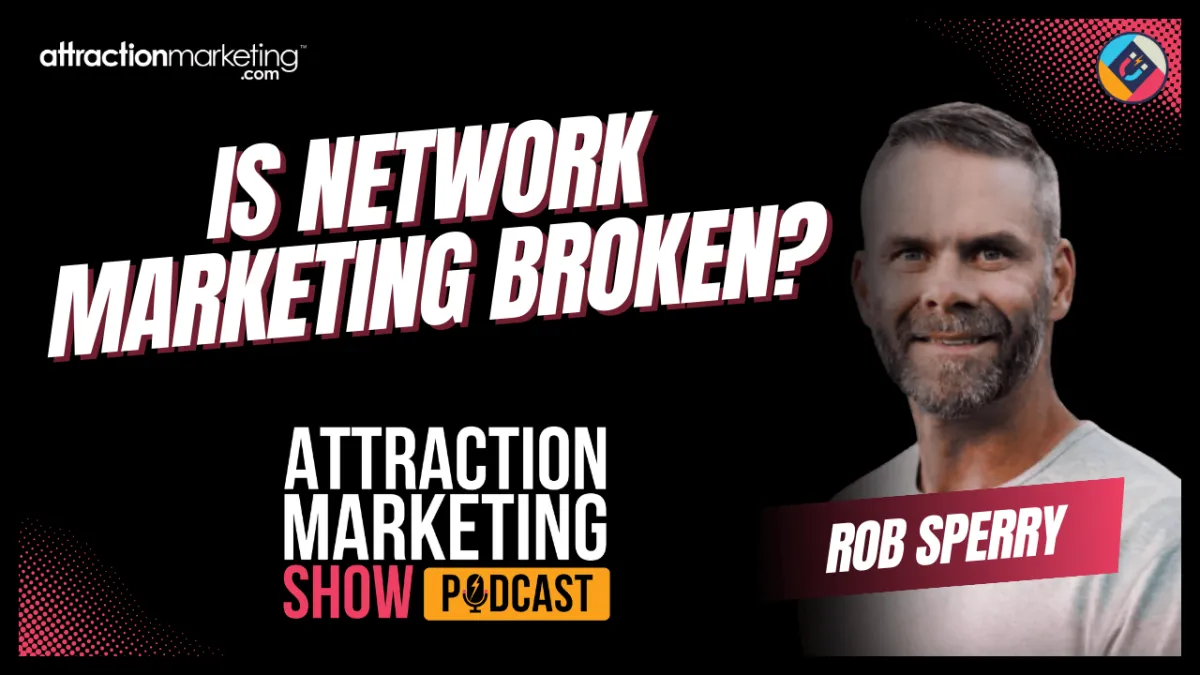
Is Network Marketing Broken? | Episode 3
Season 1, Episode 3 | The Attraction Marketing Show
Rob Sperry almost never joined network marketing.
He was approached eleven times. Turned it down every time. Thought it was beneath him.
Then somebody cast a vision that stopped him cold — not by selling the compensation plan, not by hyping the products, but by describing a life where every single day felt like an anniversary.
That conversation changed his trajectory. What happened next built one of the most respected careers in the profession.
In Episode 3 of the Attraction Marketing Show, host JT DeBolt sits down with Rob — and halfway through, Ferny Ceballos joins the conversation for the first time on the show, turning a great interview into a frank round-table on what's actually broken in network marketing right now and how to fix it.
This one is worth reading slowly.
The Man Behind the Brand: Who Rob Sperry Actually Is
Rob grew up in Utah. He was a tennis coach and club manager who spent years buying every small business magazine he could find, studying successful people, and trying to figure out how to become an entrepreneur.
He wasn't taking much action. But he was preparing.
At sixteen, he lost someone close to him. That loss gave him a perspective on time that most people don't develop until much later in life.
"I felt like a ninety-year-old at sixteen. When you experience that kind of loss, it does something to you. It makes you feel how short life really is."
He later discovered a quote that crystallized everything he'd been feeling: Die with memories, not dreams.
That became his operating principle. Not a motivational poster. A filter for every decision.
Today he's been married for twenty-two years, has four kids between the ages of eleven and twenty, coaches high school tennis teams as a volunteer, and runs teenage mastermind sessions — over thirty-eight of them in the last three years alone.
The business exists to fund and protect the life. Not the other way around.
The Eleven Companies He Said No To — and the One That Finally Got a Yes
Living in Utah means getting pitched on network marketing constantly. Rob turned down eleven companies before he ever said yes.
What finally changed his mind wasn't a product or a comp plan. It was a mentor — a legend in the industry who came to him with a different kind of offer.
"He said, this will be the hardest thing you've ever done. Everyone else told me it was easy. He told me it was hard. And then he said — someday, every day will feel like an anniversary."
That mentor described a life where his hobby was his family. Where he showed up for every game, every school event, every moment that mattered. Where time freedom wasn't a tagline but a daily reality.
Rob was in.
What followed was harder than even that honest mentor had described.
Month Five: Eighty Hours a Week, Less Than Four Hundred Dollars
Five months into going full-time in network marketing, Rob's check was going backward.
He'd quit running the tennis club. He was working more than eighty hours a week. His check came in at under four hundred dollars for the month.
His mentor didn't coddle him.
"He said, I can't fault your work ethic. But how you're spending your time isn't going to cut it. Working this business means talking to new people. Everything else is noise."
That conversation stung. And it was exactly what Rob needed.
He restructured. His volume tripled. He never dropped below that level again.
But more importantly, he learned a lesson that now shapes everything he teaches:
Hours don't equal productivity. Busy is not the same as building a network marketing business online. The comp plan doesn't care how many hours you worked. It pays on results.
The Two Questions Everyone in Network Marketing Is Really Asking
Rob teaches that there are only two questions that matter when someone is deciding whether to keep going — or when anyone is deciding whether to start.
Can I do it?
Is it worth it?
Every moment of doubt, every foggy patch, every temptation to quit — it comes back to one or both of those questions.
"My fears were at a nine-point-five out of ten. My goals and dreams were at a ten. So I won more battles than I lost. That's all it took."
He's clear that this wasn't natural talent or exceptional ability. It was grit. The willingness to stay in the room when the emotions got loud and the vision got foggy.
And his honest take on grit is refreshing: yes, some people are born with more of it. But anyone can develop it. The path is through non-negotiable minimum standards.
Non-Negotiable Minimums — The Habit System Nobody Talks About
Rob has studied personal development every single day for seventeen years.
Zero missed days.
But here's what makes that streak actually sustainable — it's not that he does an hour of reading every day. It's that his minimum non-negotiable is thirty seconds.
"I don't miss it because the minimum is so low I can't make an excuse. Thirty seconds. That's it. But my standard goal is an hour. The minimum keeps the habit alive on the hard days."
This three-tier goal structure — ideal goal, standard goal, minimum non-negotiable — is something Rob applies to every area of his business and life. And it's the piece most people skip.
They set a huge goal, fail to hit it once, and use that failure as evidence they can't do it. They never consider that a lower floor might actually get them to a higher ceiling.
Small consistent wins change identity. And identity determines behavior far more than motivation ever will.
What He Had to Unlearn — The Grit Trap
For most of his early career, Rob equated grit with working more hours. More time in meant more results out. That was the equation.
It was wrong.
"I was working three hundred and twenty hours a month. But my actual time talking to new prospects? Less than one percent of that. I could have worked five hours a week on that one activity and done more."
The comp plan doesn't reward hours. It rewards conversations, enrollments, and duplication.
When you've spent your whole life in a world where hours equal pay, that transition is genuinely hard to make. Your new boss is your calendar. And most people have never been their own boss before.
Rob eventually learned to treat his calendar with the same seriousness as any external appointment. Priority blocks that only moved — never canceled. Commitments to himself that he honored the way he'd honor commitments to anyone else.
Marry the Process, Date the Results
A lot of leaders teach people to divorce their results entirely. Don't look at the numbers. Just focus on the process.
Rob disagrees — slightly but importantly.
"I don't divorce the results. I date them. Results are great feedback. But I don't marry them, because marrying them means a bad week destroys you and a great week makes you overconfident. Marry the process. Date the results."
This distinction matters more than it sounds.
Results tell you what's working. They give you data. But they shouldn't determine your identity or your commitment level. The process is the constant. The results are the information.
Three years in — after more challenges than most people face in ten — Rob says he finally found his groove. Not because things got easy, but because he stopped being surprised when they got hard.
From Network Marketer to Industry Oracle — The Accidental Career
Rob used to make fun of coaches. If you can't build, go coach. His words.
Then he built. Then he coached. Then he became exactly the person he used to mock.
He's the first to point out the irony.
After years of building, he wrote a book called The Game of Networking. Teams and companies started asking him to speak. By 2016 he sold his position in the field and made a decision: he was done building downlines. He was going to help leaders build better.
"I said I'm not going back in the field. They said everyone says that. I said — when I say it, I mean it. I'll prove it over the years if you don't trust me now."
That's led him to keynote speaking, consulting for network marketing companies, and coaching six and seven-figure earners — a private group where Ferny Ceballos is a regular contributor.
His podcast, Network Marketing Breakthroughs with Rob Sperry, is approaching three hundred episodes. His Facebook group The Game of Networking publishes free deep-dive content daily.
Ferny Joins the Conversation — What's Actually Happening in Network Marketing Right Now
Midway through the episode, Ferny Ceballos joins the recording — the first time he's appeared on the show since his own interview in Episode 1. What follows is one of the most honest conversations about the current state of the industry you'll find anywhere.
Ferny opens with something most people in the space aren't willing to say out loud: the industry is in a weeding-out season. And that's not necessarily a bad thing.
He walks through the full arc — the FTC and Vemma situation around 2015-2016, the shift to customer-based models, the Amazon Prime effect raising consumer expectations overnight, the explosion of the opportunity economy with Uber and Airbnb, the COVID bump followed by a social media recession, inflation squeezing household budgets — and makes the case that every one of these forces has been pushing the network marketing model to evolve.
"It's not algorithms. You have a hundred times more reels than you used to have. Your expectations are higher. You're more bored. There's no algorithm change on that. It's just changed expectations."
Companies that adapted are thriving. Companies that didn't — or that were propped up by COVID-era conditions — are closing.
His conclusion: when you're in a dip, you get creative. You get smarter. And the ones who make it through this period are going to be better positioned than they've ever been.
How to Choose a Network Marketing Company — Rob's Honest Criteria
This section of the conversation is genuinely useful for anyone in the industry right now, whether they're evaluating a new company or questioning whether to stay in their current one.
Rob gets asked this privately three times a week. Here's what he actually looks for:
First and most important — by a wide margin — is who owns the company. Everything else flows from this. Great owners navigate storms. Bad owners cut comp plans and kill events the moment cash flow gets tight.
"Inevitably you're going to go through storms. The question is whether the captain can navigate them. That's the owner. It's not even close — that's number one."
His specific warning: private equity-backed companies are the highest risk. Private equity is built to flip, not to build long-term. Network marketing requires a long-term vision. The two are fundamentally incompatible.
Second: leadership in the field. The quality of who you're building beside matters enormously — for systems, vision, duplication, and retention.
Third: is the product something people would buy even if there were no business opportunity attached? If the answer is no, the model is fragile.
Fourth: comp plan allocation — not how much it pays, but where the money goes. Is there enough on the front end to create duplication? Is corporate funded well enough to support events and retention?
Do You Have Another Run in You? The Most Important Question Nobody Asks
For anyone considering leaving their current company, Rob has one question he asks before anything else — and it's not about the company at all.
"Do you have another run in you? Because I've seen people put in three, four, five years, leave, and they only had six months left in them. They were already burned out. They were playing lottery ticket marketing, not network marketing."
If the answer is genuinely yes, then the next question is whether you believe the company can turn around. Not certainty — belief. Because every company goes through highs and lows. Apple had lows. Tesla had lows. If you believe in the vision and the ownership, staying and recommitting may be the right move.
If you decide to leave, don't chase the first shiny thing. Evaluate at least five options with real criteria. Give yourself a proper window — six months of heads-down commitment — before you reassess.
Never make a major business decision based on one person you could put in your downline.
What Rob Would Fix With a Magic Wand
JT asks both Rob and Ferny what they'd change about network marketing if they could wave a magic wand. Their answers point to the same root problem from two angles.
Rob's answer: the industry has become too incestuous. Too much energy goes into recruiting people from other companies instead of attracting people who've never tried network marketing before.
"You have to be so good that the person who's never done network marketing looks at what you're doing and says, wow — that's different than I thought. That's the goal. And ironically, when you build that, you attract all the people who were going to leave their companies anyway."
Ferny's angle: the companies that survive this period will be the ones that genuinely retain customers — not just recruit them. The systems behind the scenes, the communication, the experience after someone joins — most companies have left that entirely to their distributors. That's not sustainable.
Both answers point to the same shift: from extraction to attraction. From taking to building. From short-term recruiting to long-term value.
Which, not coincidentally, is exactly what attraction marketing has been teaching for two decades.
The Thing That Doesn't Change — No Matter What Happens to Your Company
One of the most clarifying moments in this episode comes near the end, when Rob says something simple that cuts through all the noise about company risk, industry trends, and market conditions.
"The best thing you control is your network and your skill set. No matter what happens with the company, those are yours."
Your email list. Your personal brand. Your ability to attract people to you. Your reputation as a leader.
These aren't company assets. They're yours.
That's the core of what attraction marketing teaches — and why it matters more now than ever. Not as a safety net. As a foundation.
Build the skills. Build the audience. Build something nobody can take from you.
─────────────────────────────────
Ready to Put This Into Practice? Here's Your Next Step.
This episode was made for network marketers who know there's a better way to build — and are ready to find it.
The Digital Recruiting Bootcamp is a free step-by-step training on how to attract qualified prospects online, enroll with confidence, and build a team that actually duplicates.
No cold messaging. No home parties. No cringe.
👉 Click here to get free access and get started today.
─────────────────────────────────
And if you haven't subscribed to The Attraction Marketing Show yet, now's the time.
New episodes drop every week —real conversations with the people who built this movement.