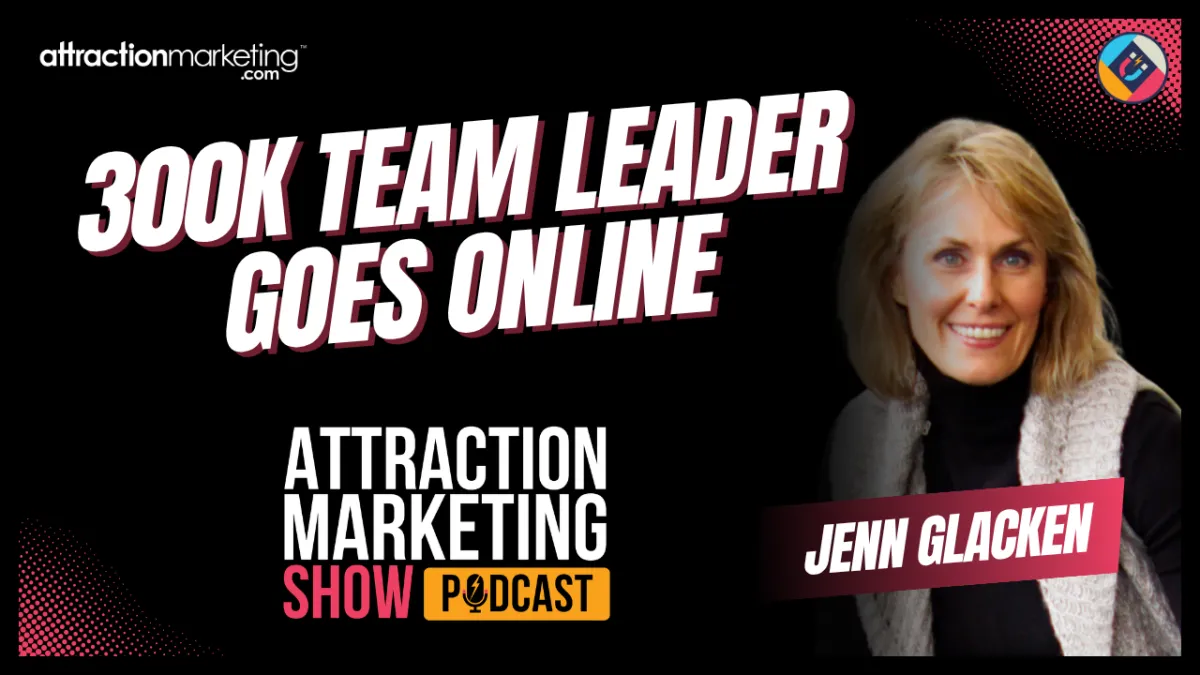
How a Legacy Leader Brought Her Team Online | Episode, Part 5
Season 1, Episode 5 | The Attraction Marketing Show
Jenn Glacken has been with the same network marketing company since 1992.
Thirty-plus years. One company. A team that now numbers well over 300,000 people.
She built the first two decades entirely offline — home parties, craft fairs, farmer's markets, phone calls, paper newsletters she folded by hand at her desk. She didn't transition to building online until 2017. And when she did, she had to learn almost everything from scratch.
In Episode 5 of the Attraction Marketing Show, host Andrew from AttractionMarketing.com sits down with Jenn for one of the most grounded, practical conversations the show has produced. She covers the arrogance trap that almost derailed her online transition, the team target market breakthrough that unstuck her entire organization, what she's doing with AI that most people haven't thought of yet, and why the industry's fake-it culture is one of its biggest self-inflicted wounds.
This episode is for anyone who's built something real offline and is trying to figure out how to carry it into the digital world — without throwing away what works.
A Product Story That Became a Business
Jenn didn't join network marketing to build a business. She joined because her son had respiratory issues and someone on her doorstep kept suggesting environmentally safe cleaning products.
She finally took them — mostly to get the woman to stop coming back.
Within three days, her son's symptoms improved enough that she became a genuine believer in the products. She started sharing them with friends and family. She was getting bonus checks. She just didn't think of it as building a business.
"For six and a half years I was sharing, and I was actually at the second leadership level in our company — even though I technically wasn't building a business. I was just sharing."
That changed in 2000 when her husband lost his job. She was homeschooling her kids, deeply involved in her church, and had no interest in going back to corporate life. The solution was already in her hands.
She went to a leadership seminar in Chicago that January. A speaker on stage said something simple: talk about the business, not just the products.
She did. Within eight months she was making four to six thousand dollars a month. In her first year she sponsored ten business partners who all reached the introductory leadership level. Entirely offline.
The Mistake She Made Coming Into Attraction Marketing
By 2017, Jenn's team was demanding a process for building online. She had a large organization and no system for the digital world. She went looking for one.
She'd actually heard about Mike Dillard and Magnetic Sponsoring back in the late nineties — and bought the book. But she was homeschooling, deep in family life, and never followed through. When she eventually found AttractionMarketing.com, she recognized Ferny from those early days and jumped in immediately.
She made one significant mistake coming through the door.
"I came in only to get a process for my team. I didn't come in to learn for myself how to build online. And that was a huge mistake. I would tell anybody: you have to go in for yourself first. I don't care if you've built a huge organization. You have to go in and figure out how to build it online yourself first — then you can teach your team the steps."
This is a trap that legacy leaders fall into constantly. The assumption that their track record exempts them from being a student. That their job is to collect the information and distribute it — not to integrate it personally.
For Jenn, the reckoning came when she started teaching her team target market concepts before she'd fully worked through them herself. Her top leaders got stuck. They went around and around the target market table, confused and frustrated, because she was teaching something she hadn't yet owned.
She had to go back. Start from ground zero. Sit in every learning environment as a full student — notebooks, rewatched videos, the whole thing.
"It transformed me as a leader. I would've said I was resourceful before — but I wasn't, not to the degree I am now. I feel like I am so equipped to go out and figure anything out. Everything's figureoutable."
The Team Target Market Solution
Once Jenn committed to learning for herself, the next challenge was adapting what she'd learned for a team of thousands — many of whom had never been on social media in a business context.
The standard attraction marketing approach to target market — the deep individual niche work — was too granular for her team to execute consistently. They kept getting stuck.
Her solution was a team target market: a shared umbrella that gave everyone a starting point without requiring each person to work through the full framework alone.
"We landed on stress as the umbrella. Everybody comes to stress with a different perspective — somebody feels overwhelmed, somebody feels like they can't get it all done, somebody can't sleep. We all have different ways of describing it. So everybody operates from their own personal version of stress, with content and verbiage that resonates with them."
From there she built content systems that let team members personalize within the framework rather than build from scratch. Quote graphics, story prompts, social post templates — all designed so someone new to social media could show up consistently without the paralysis of a blank page.
Her launch process reflects the same thinking. New team members get a seven-day pre-launch, a seven-day launch, and then 120 days of pre-created daily content. The goal isn't to do the work for them forever — it's to build the habit of consistency during the critical first four months while they're also learning products, comp plan, and mindset.
"When you post 120 days consistently, you've now developed a habit that's hard to break. That was the real purpose. I was buying my team time — and buying myself time to get all the cats corralled and moving in the same direction."
Building for the Team That Hasn't Found You Yet
One of the most important mental shifts Jenn describes is the reframe that finally unlocked her commitment to building online.
When she started, she made the mistake most legacy leaders make — she tried to build an online system for the people already on her team. Many of them were resistant. They didn't want to go online. They'd built successfully the old way and saw no reason to change.
The shift came when she stopped trying to convert the existing team and started building for the future team.
"I decided I wasn't building an online system for the people I had. I was building an online system for the people who hadn't found me yet. And when people heard that, it actually created FOMO. They didn't want to miss out on what was being developed."
About fifty percent of her team adopted the first version of her launch process. The second iteration, launched in 2025, brought it to another level — opt-in pages, automated text sequences, email threads, a full digital duplication engine that runs whether she's working or not.
This is what building a network marketing business online actually looks like at scale — not replacing the relationship, but systematizing the on-ramp so more people can find their way to one.
The Old Skills Still Work — You Just Have to Translate Them
One of the more nuanced points Jenn makes in this episode is that going online doesn't mean throwing away everything that worked offline. It means translating it.
The best skills she developed over twenty-five years of offline building — asking questions, listening for needs, connecting products to problems, developing leadership — are just as valuable online. They just live in different containers.
"You can put offline skills into automated formats. You can put leadership training into email systems, into text sequences, into video clips, into a whole YouTube channel. The skills don't expire. The delivery method changes."
She also pushes back, gently but clearly, on the tendency in the attraction marketing world to position offline building as something to be left behind. For a segment of her team, offline is still the right path. Her launch 2.0 system accommodates both — someone who wants to build exclusively online can skip the offline pieces, and someone who prefers offline can skip the digital ones.
The goal is a system that actually works for the person using it. Not a system that works for the person teaching it.
What Jenn Thinks Everyone Is Getting Wrong About AI
When the conversation turns to AI, Jenn has a take that cuts against how most network marketers are using it — and it's worth sitting with.
Most people, she says, are using AI as a content machine. Ask it for a reel idea. Ask it for an email. Ask it for a training outline. Treat it like a very fast Google search.
She thinks that's almost entirely backwards.
"The power of AI is really having it get to know you so well that it can completely mirror you. Then it can be a therapist, a coach, a mentor — guiding you down a path toward what you've told it you actually want to accomplish."
She spent six to seven weeks doing exactly this — running through Myers-Briggs and DISC profiles, answering dozens of questions about how she handles different situations, sharing personal history going back to high school, giving her AI a detailed picture of who she is professionally and personally.
The result: her AI can now write content for her that she reads and doesn't need to edit. It references her past experiences in coaching sessions. It pushes back when her plans don't line up with the goals she's told it she has.
She's also clear on one thing: the first answer AI gives you is almost never the right one.
"I'm the boss. I'm the human running this. If it gives me an answer, I'll say — on a scale of one to ten, how would you rate that? It says an eight. I tell it I think it's more like a five. Then we work toward an eight or nine together. You have to be discerning. You can't just take whatever it gives you."
Two people on her team have now gone through a similar deep-dive process. She's watching what it does for their output. The floodgates, she says, are opening.
The Fake-It Culture That's Rotting the Industry From Inside
Jenn closes with something that many people in network marketing think privately but rarely say out loud.
She's tired of the performance.
The person in front of the leased Mercedes. The international travel content that implies an income that isn't there. The top leader label slapped on a profile that doesn't hold up to scrutiny. The training manual — she saw one distributed just last week — teaching a "Hey girl" DM script and calling it attraction marketing.
"People buy into the fake lifestyle and then you've got a team of people expecting to live something that maybe they can't live. I want my people to be real and authentic. I want them to understand what it takes to build a business — that it takes work, discipline, and consistency. This is not a get-rich-quick scheme."
Her point is not that success isn't possible. It's that the gap between what's projected and what's real is what destroys trust — in individual leaders, and in the industry as a whole.
The antidote isn't a more compelling pitch. It's actually being the thing you claim to be. Building real systems. Getting real results. Teaching what you actually know. Showing up as a human first.
That's what she's been doing for thirty-plus years. It's why her team is still growing.
"If you don't change, you're standing still — and you don't really stand still. You go backwards. The world is changing so fast that if you don't jump on board, you're going to be irrelevant. Change is inevitable."
─────────────────────────────────
Ready to Put This Into Practice? Here's Your Next Step.
This episode was made for network marketers who know there's a better way to build —and are ready to find it.
The Digital Recruiting Bootcamp is a free step-by-step training on how to attract qualified prospects online, enroll with confidence, and build a team that actually duplicates.
No cold messaging. No home parties. No cringe.

─────────────────────────────────
And if you haven't subscribed to The Attraction Marketing Show yet, now's the time.
New episodes drop every week —real conversations with the people who built this movement.