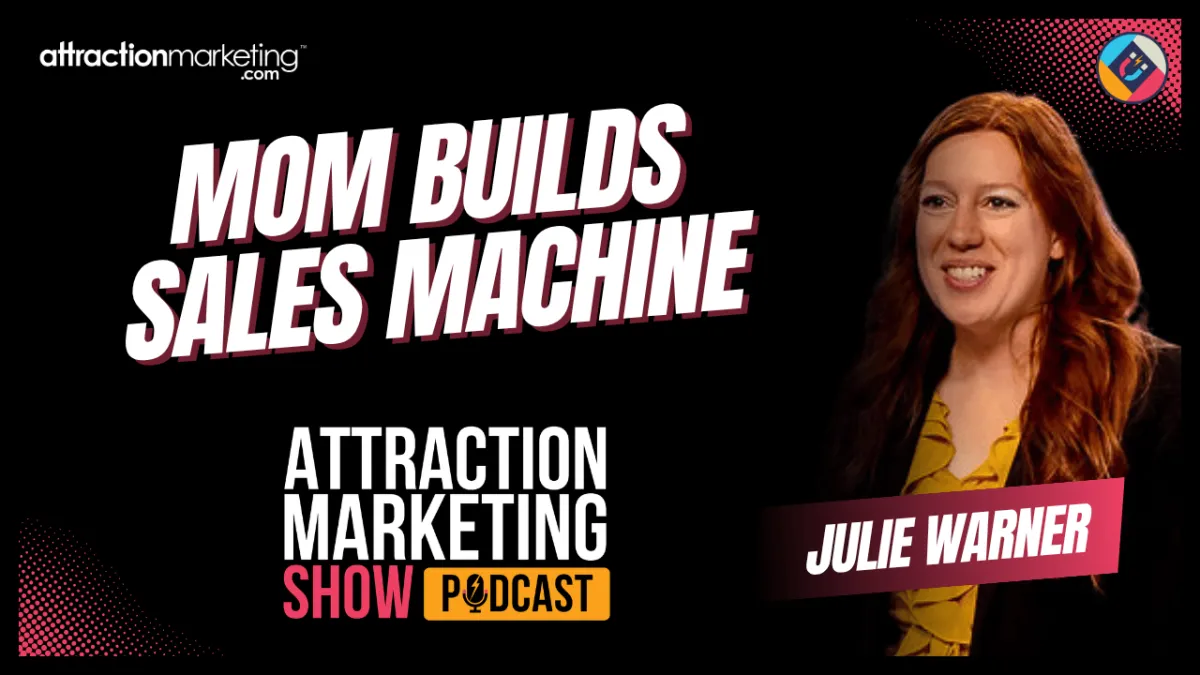
Julie Warner: How a Stay-at-Home Mom Built a Sales Machine | Episode 6
Episode 6 | The Attraction Marketing Show
Julie Warner started network marketing in 2019. She had a newborn, a house in Utah, no extra money, and a list of vendor events every weekend that were slowly grinding her down.
By October 2024 she hit her first thousand-dollar month from an online funnel. By February 2025 she crossed ten thousand. In the sixty days before this episode recorded, she generated over eighteen thousand dollars — and enrolled three new team members in ten days using a launch sequence.
She did it as a stay-at-home mom with two kids under three. No massive following. No stage credentials. Just a relentless approach to figuring things out, a funnel she built herself, and a decision to stop doing what wasn't working.
In Episode 6 of the Attraction Marketing Show, host JT DeBolt sits down with Julie for a conversation that's equal parts practical and inspiring. She breaks down paid ads, funnel mechanics, target market precision, the warm list trap, and why being approachable beats being impressive every single time.
From Vendor Events to a Funnel That Runs While She's at the Park
Before she found attraction marketing, Julie was grinding vendor events every weekend. Ten to twelve hours on her feet. Kids left with her husband. Setup costs, booth fees, and no guarantee of making them back.
It worked — sometimes. But it wasn't duplicatable. She knew that clearly.
"If I turned around and said, hey teammate, go do this — they'd say no. And I get it. Not everyone's built like that. So I knew I needed something I could actually teach."
She started researching how to build her network marketing business online. Found AttractionMarketing.com. Made the decision to focus on the automated roadmap — paid ads and funnels — because with two small kids, she needed a system that didn't require her to be on social media every hour of the day.
She built her first funnel in June 2024. It started moving in August. The progression from there was methodical: a hundred-dollar month, then a thousand, then ten thousand, then eighteen thousand over sixty days.
One of her best-performing ads is a video of her and her daughter cooking at the stove — an ordinary kitchen moment, no face shown, no fancy production. Just her life as a network marketer. Real. Relatable. Converting.
How a Funnel Actually Works — No Jargon, No Engineering Degree Required
Julie is one of the clearest teachers of funnel mechanics the show has featured, and she strips the concept down to its most useful form.
"A funnel is just bringing someone from point A to point B — from this stinks to now it's great. It can be simple. You put a post out, put some money behind it, and someone lands on an opt-in page. They get a freebie to their email. From there they're nurtured until they're ready to buy. When they book a call, it's on my calendar. I don't have to reach out to anyone."
The beauty of the system isn't that it removes human connection. It's that it brings the right people to that connection point on their own terms. By the time someone books a call with Julie, they've already opted in, consumed value from her emails, and decided she might be someone worth talking to.
She doesn't chase them. They come to her.
And she's clear about what it takes to get there. The creative — the video or image someone scrolls past before deciding to click — is where most of the real work lives. Specifically the hook. The first three seconds.
"If people aren't watching the first three seconds, they're scrolling. There's a metric in Ads Manager that tells you exactly that. If it's not working, you either rewrite the hook or scrap the whole thing and start over. I was writing a new ad every single week at one point. That's the job."
She also makes an important practical point for anyone intimidated by the tech side: the AttractionMarketing.com affiliate program has pre-built funnels. You don't have to build one from scratch. You can even use Ferny's video in the funnel if you don't have your own yet. The barrier to entry is lower than most people think.
Organic vs. Paid: The Right Question to Ask Yourself
Julie gets asked constantly which path to take — organic content or paid ads. Her answer doesn't pick a winner. It asks a better question.
"Do you want to give up time or money? Organic means creating reels, posts, comments, all the things, every day. Paid means putting in some money and time to learn the tech. Neither is easier. They're just different trade-offs."
She started with paid because her time was the constrained resource. Two kids at home meant she needed a system that could run independently. The ads gave her that.
Her advice for anyone trying to choose: pick one and get it working before adding the second. She tried to do both simultaneously early on and mentors told her to pick. She resisted — she's the type who wants to do everything — and eventually understood why the focus mattered.
You can't optimize two things at once when you're still learning both. Get one producing results. Then stack the second.
The Nurture Phase — What It Actually Means to Provide Value
One of the most misunderstood parts of any funnel is what happens after the opt-in. Julie describes her approach to email nurturing in a way that cuts through a lot of the noise around content strategy.
"I give them all my secrets. I want them to say — wow, Julie actually knows what she's talking about, and she's genuinely helpful. Not in an I'm-on-a-pedestal way. I want them to feel like I can help them get a win today."
Her emails come from her organic reels — she repurposes what she's already creating on Instagram rather than building separate content for each channel. A reel becomes an email. The same idea serves two audiences without doubling the work.
The driving question behind every piece of content she sends: what could actually help this person get a win right now? Not what will make me look impressive. Not what will get the most likes. What does the person on the other end actually need?
That orientation — help first, sell second — is what she teaches on AttractionMarketing.com's coaching calls. And it's the thing she sees missing most often in the people who can't figure out why their funnel isn't converting.
"We lead with the sale in our heads because we want it. But if I don't know you, you have to build to that point. If you don't have that base of people who care about what you have to say — even if they did buy, they'd be out the window the next day."
You Don't Need a Big Following. You Need to Be Approachable.
Early in her journey, Julie had fifty to a hundred followers on Instagram. Someone reached out and said: I can see you don't have a lot of followers, but you're somehow rocking it — tell me your strategies.
That message came entirely because of the content she was putting out. Not her follower count. Not her rank in her company. Her content.
She and JT use this moment to make a point the industry consistently gets backwards: massive influence creates distance. Approachability creates conversations.
"Somebody at the top of their company — am I as somebody struggling at the bottom going to talk to them? Maybe. Maybe not. But I'm definitely going to talk to someone who's been in my shoes recently. You know what I need right now. Somebody who achieved this ten years ago might not know the skills that are needed today."
The logic applies directly to content strategy. You don't need to look like you've made it to attract people who want what you have. You need to look like someone they can actually reach. Someone who gets it because they're close enough to the problem to remember what it felt like.
That's not a consolation prize for not having a big platform. It's a genuine competitive advantage — and one that disappears the moment you start performing a lifestyle you don't actually have.
She Went Rogue — And It Paid Off
One of the most instructive moments in this episode comes when Julie describes a conversation with Ferny that changed the direction of her business.
Her whole team was promoting one specific product. She felt pressure to align. But there was another product she actually believed in — one with thirteen thousand documented testimonials and before-and-after photos she could point to.
Ferny asked her one question: why are you promoting that product?
"I told him because my whole team has the resources for this one. And he said — yeah, but what's actually going to sell? And I realized everyone else was struggling to present this product too, because there weren't really before and afters. So I went rogue. I promoted the one I could actually show results for."
What happened: she had real stories. Real pictures. Real transformations she could point to. Her content became specific and credible in a way that generic product promotion never could be.
It also taught her the most important lesson about target market: the product that reaches the most people isn't the one that's right for everyone. It's the one you can tell a specific story about to a specific person who immediately thinks — that sounds like me.
"Same solution. Completely different message. If you have a story they can relate to, it hits way different. And if your story matches the product — that's everything."
What She Would Fix About Network Marketing
When JT asks Julie what she'd change about the industry if she could, her answer goes straight to the source of most new distributor suffering.
The warm list. The hundred-person contact list. The call-everyone-you-haven't-spoken-to-since-high-school strategy.
"You have zero relationship with those people. They feel weirded out by it. And then it makes the person doing it feel not confident about their ability to sell — which isn't even true. It's just that they talked to the wrong people. You're not bad at sales. You're doing something that's a no-win situation."
Her alternative is straightforward: create new relationships by talking about things you genuinely care about. Let people naturally come to you with questions. Then you're having a conversation with someone who's already indicated interest, already sees you as credible, and already wants to know more.
That's not a complicated system. It's just attraction marketing — applied from the first day, before any funnel, before any ad, before any rank advancement.
Show up as a real person talking about real things. The right people will find you.
From a Hundred Dollars to Eighteen Thousand — What the Journey Actually Looks Like
Julie's trajectory over the past year is worth mapping out because it shows what honest, patient execution actually produces.
June 2024: builds her first funnel. August: it starts gaining traction. October: first thousand-dollar month. February 2025: first ten-thousand-dollar month. April 2025: over eighteen thousand in sixty days. Plus three new team members enrolled in ten days using a launch sequence.
She's quick to point out that she didn't know any of this was possible when she started. The scale felt abstract until she was inside it.
"I didn't even know this type of thing could happen. I went from a hundred dollars, and now we're at ten-plus. And what's next? Six figures. Then after that — I don't know, let's shoot for seven. We're pointed in the right direction. Let's throw gas on it and see how far it goes."
There's something deliberate about the way she holds her goals — pointed forward without crushing herself under a deadline. Progress as evidence. Each milestone as proof that the next one is reachable.
She also makes a point of appreciating every single sale. Not as a performance of gratitude but as a genuine acknowledgment of what it took to get there — and as a reminder that at some point, none of them were coming in.
"Every time a sale pops into my email, I just look at it and think — that's cool. Attraction marketing is working. But also — I did that."
─────────────────────────────────
Ready to Put This Into Practice? Here's Your Next Step.
This episode was made for network marketers who know there's a better way to build —and are ready to find it.
The Digital Recruiting Bootcamp is a free step-by-step training on how to attract qualified prospects online, enroll with confidence, and build a team that actually duplicates.
No cold messaging. No home parties. No cringe.
─────────────────────────────────
And if you haven't subscribed to The Attraction Marketing Show yet, now's the time.
New episodes drop every week —real conversations with the people who built this movement.