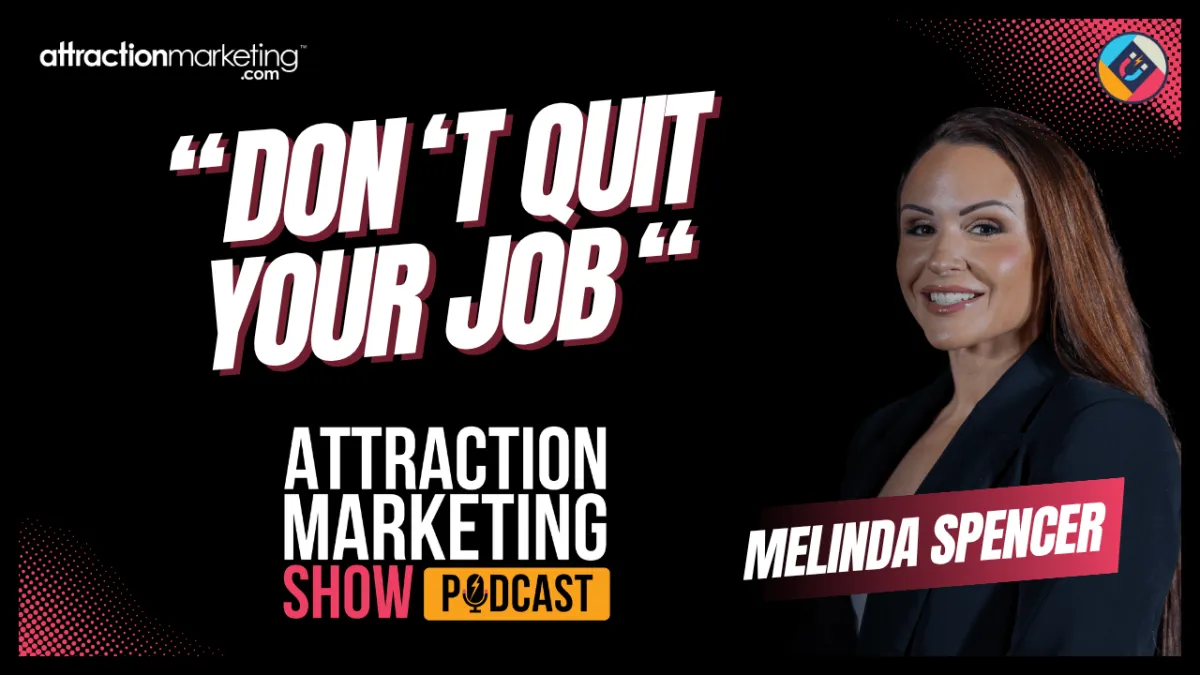
Melinda Spencer: Why She Tells Her Team "Don't Quit Your Job" | Episode 7
Episode 7 | The Attraction Marketing Show
Melinda Spencer reached the top 2% of her company while still working a full-time job.
She didn't sprint to the finish line. She didn't quit her job, max out her energy, and bet everything on a timeline. She built with intention, treated the business like a profession even while working it part-time, and created a model her team could actually follow — one that didn't require anyone to blow up their life to get started.
Nine years in the industry. D1 softball athlete. Competitive powerlifter and Spartan racer. Brazilian jiu-jitsu blue belt. Toastmasters member. The kind of person who, when she decides to do something, goes all the way.
In Episode 7 of the Attraction Marketing Show, host JT DeBolt sits down with Melinda for one of the most grounded, refreshingly direct conversations in the show's run. She covers why she tells new team members not to quit their jobs, how she built a personal brand before she ever started talking about her business, what she'd fix about the industry if she could, and why belief work has to come before strategy — every single time.
The Anti Network Marketing Girl Who Built to the Top 2%
Melinda was not a natural recruit. She was the supportive friend who hosted parties for other people's businesses and politely declined every invitation to join. She turned down eleven different companies over the years.
She went so far in the other direction that one recruiter literally followed her into her workplace bathroom and kept talking through the stall door.
It didn't work.
"I was always, please keep me away from this. Until an acquaintance at a CrossFit gym sat down with me and showed me the difference between making money as an affiliate — building something for someone else's company — and building something for myself."
That distinction landed. She was already promoting products she believed in through bodybuilding and CrossFit content. The idea of channeling that energy into something she actually owned made sense in a way that no pitch had before.
She joined. Spent her first three years casually involved — selling to friends and family, no social media, no real strategy. Her upline kept her plugged into events and culture, which she credits for keeping her from drifting away entirely.
Then she went to her first company event. She watched two people get on stage who weren't particularly good at public speaking, weren't especially polished, and weren't doing anything she couldn't do.
"I don't know how they tie their shoes in the morning. The fact that those people are making that amount of money per month — that was wild to me. And I'm sitting here treating this like maybe my mom will buy something. That was the switching point."
She flipped the switch. Within six years of active building, she reached the top 2% of her company — all while keeping her full-time job.
Don't Quit Your Job. Here's Why.
Melinda's advice to new team members is deliberately counter to what most network marketing coaches preach. She doesn't tell them to fire their boss. She tells them to keep their job.
This isn't pessimism. It's experience.
"I've seen too many people actually quit their job and then when the rollercoaster of entrepreneurship happens, it falls apart. And all of a sudden they can't rely on that network marketing income to fund what they actually need to pay for. I always say — it's a great side thing, until and unless it becomes a full-time thing. That's a decision you have to make for yourself."
The majority of people who approach Melinda want a part-time business, not a full-time identity shift. They want extra income, more time freedom, a plan B. They love their careers. They're not trying to escape — they're trying to expand.
She's built her team around that reality rather than fighting it. The model she teaches works for part-timers. The systems she uses don't require someone to be online for hours every day. The approach is designed for real lives.
"If you treat it like a hobby, it'll pay you like a hobby. But if you treat it like a profession — even part-time — it will pay you like one. I make a full-time income working this part-time. That's the proof."
The professional mindset, she argues, is the variable. Not the hours. Not the company. Not the comp plan. Whether someone shows up to their business with the seriousness of a professional or the casualness of a hobbyist determines almost everything about what they'll build.
The Personal Brand She Built Before She Ever Mentioned Her Business
Melinda's Instagram following didn't grow from business content. It grew from bodybuilding.
Years before she started talking about network marketing online, she was posting about training, competitions, races, jiu-jitsu, concerts, travel — everything that made up her actual life. People followed because they were interested in her, not because she was selling something.
When she finally started weaving her business into her content, she already had an audience that knew her.
"A rough percentage of my posts are about my offer. Everything else stays the same. I just look for ways to relate my life to business when it's natural. Jiu-jitsu connects easily — it's about the journey, about being okay with sucking before you get good, about showing up even when you're questioning why you're there. That mirrors entrepreneurship almost exactly."
For things that don't connect — like concert content — she doesn't force it. She posts it anyway. Because the point isn't to convert every piece of content. The point is to be a real person that people want to follow.
"All of your content can't be your offer. People do business with people they know, like, and trust — people they can see themselves in. Even if someone sees that I was at a rock concert and has zero interest in network marketing, they might follow me. And somewhere down the Breadcrumb Trail, they might find their way to what I do."
This is what building a personal brand looks like before the tactics — before the funnels and the launch sequences and the DM scripts. It starts with showing up as a full person and letting people decide if they want to be in your world.
How to Build a Personal Brand When You Have No Idea Where to Start
Melinda's advice for someone starting from zero is direct and practical. No complicated frameworks. No overwhelming strategy sessions.
Start with three pillars — three things you genuinely care about. For most people in her orbit, it's some combination of family, fitness, and personal growth. For her it's athletics, travel, and the business.
Post about those things. Consistently. Without worrying about tying every single post back to your product or opportunity.
"Did you run ten miles today before work? That's awesome. Post it. How many people would be inspired by that? You're not bragging — you're just posting about yourself. Don't worry about connecting it to your business. Just post it."
She also addresses the paralysis problem directly. The perfectionism that keeps people from ever hitting publish. The fear that the first reel will look bad.
It will. That's fine.
"I look back at some of my first reels from about a year and a half ago — filmed in a car, terrible lighting — and I'm like, what was I thinking? But you have to rip the bandaid. You're going to suck before you get good. Be okay with it. The fear of looking bad is stopping you from building anything at all."
Her launch process for new team members reflects the same principle. They get a framework — static post, carousel, reel, caption idea — and then the instruction is to make it their own. Not copy it. Take the structure and put themselves into it. Because a copied voice doesn't attract anyone. A real one does.
Belief Before Strategy — Every Time
One of the most consistent patterns Melinda sees in the people who come to her for help is that the real obstacle isn't knowledge. It's belief.
They think they're too busy. They think nobody will listen to them. They're waiting to lose ten pounds, or hit a certain rank, or have something impressive enough to say before they start.
"You can teach strategy all you want, but if they don't believe they can do it, it doesn't matter. I can't just hand someone a system when they're sitting in the back of their head thinking — I don't have enough time, I'm not good enough, who's gonna listen to me? You have to work on belief and strategy at the same time."
Her preferred approach with new team members is an introductory call before they start building — not to pitch them on tactics, but to surface the hangups. To find out what story they're telling themselves about why this won't work for them. And to start replacing it with evidence.
Because the first win does more for belief than any training session ever could. That's why helping someone make their first paycheck lights her up more than any personal milestone.
Hope is powerful. But belief — earned belief, the kind that comes from doing the thing and watching it work — is what actually keeps people building.
The Industry Problem She Can't Stop Ranting About
Ask Melinda what she'd fix about network marketing and she doesn't hesitate.
Copy-paste prospecting. The generic DM blast sent to someone who hasn't been looked up, whose page hasn't been scanned, whose products or interests haven't even been glanced at.
She received one recently — from someone promoting a product that had absolutely nothing to do with anything on her profile. Not even close. She sent a voice message back.
"It's fine if you're going to pitch me on something — I'm in the industry, I get it. But if you copy and paste a message to someone without even looking at their page for five seconds, you've lost that person forever. You're not addressing them. You're not addressing their problem. You're assuming they have a problem they don't have."
Her prescription is simple: understand your personal brand before you start selling anything. Know who you are and why people would follow you. Then, and only then, figure out how to connect that to what you offer.
Five hundred raving fans, she argues, will outperform fifty thousand passive followers every single time. The number on your profile is irrelevant if the people behind it don't actually care about what you have to say.
"You don't have to be a social media influencer to do well in this industry. You can have 500 to 1,000 followers who are genuine fans and do really well. But those followers have to be there because of you — not because of a message you were told to send."
Why the Industry Isn't Going Anywhere — And Why That's the Point
Despite the company closures, the algorithm complaints, the general anxiety in the network marketing space right now — Melinda is not worried about the industry's future. She's optimistic about it.
"Everyone's freaking out because companies are closing. But the industry itself is not going anywhere. And the ability to build a business from your phone or laptop, from anywhere in the world — that's incredibly valuable. You don't know what's going to happen to your plan A. You need a plan B."
Her own decision to join a company with a long track record was intentional. Not everyone needs to make that same choice. But she made it because she was building for the long term, not the short-term excitement of a startup opportunity.
The through-line from her very first event — where she watched two people on stage who weren't particularly impressive and decided she could do what they were doing — to the top 2% of her company, to the team she's building online now, is consistent. She decided. She committed. She treated it like a profession.
The specific tactics have evolved. The content strategy has changed. The platform has shifted from in-person to online. But the underlying posture — show up as a real person, serve the people in front of you, and never stop building — has stayed exactly the same.
─────────────────────────────────
Ready to Put This Into Practice? Here's Your Next Step.
This episode was made for network marketers who know there's a better way to build —and are ready to find it.
The Digital Recruiting Bootcamp is a free step-by-step training on how to attract qualified prospects online, enroll with confidence, and build a team that actually duplicates.
No cold messaging. No home parties. No cringe.
─────────────────────────────────
And if you haven't subscribed to The Attraction Marketing Show yet, now's the time.
New episodes drop every week —real conversations with the people who built this movement.