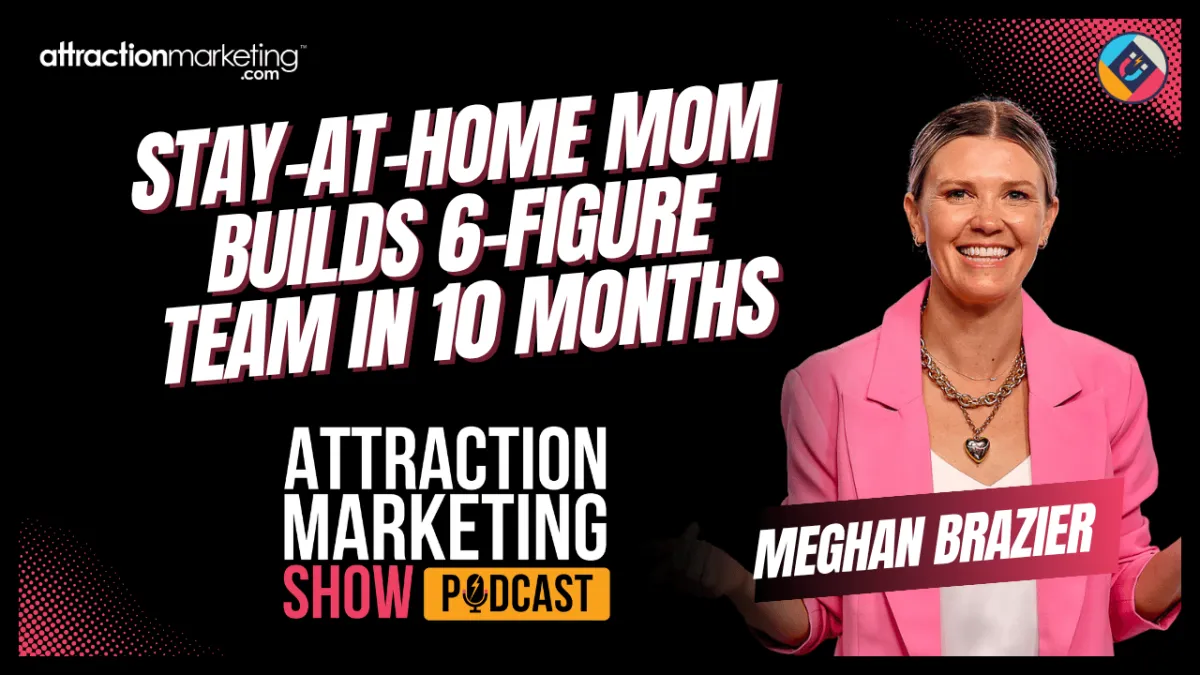
Meghan Brazier: From Stay-at-Home Mom to 6-Figure Team in 10mo. | Episode 8
Episode 8 | The Attraction Marketing Show
The story started with a rug.
A thousand-dollar rug Meghan Brazier wanted for her house that wasn't in the budget. She was seven months pregnant, hadn't worked in two years, and her husband said no.
So she found a way. Her first month in network marketing paid her $1,029. The rug was the first thing she bought.
That was 2016. Nine years later, she's a six-figure earner, a top trainer inside AttractionMarketing.com, a team builder who hit six figures in her first ten months with a new company, and one of the most genuinely effective teachers in the community.
In Episode 8 of the Attraction Marketing Show, host JT DeBolt sits down with Meghan for a wide-ranging conversation that covers the systems she built to scale her team, how she uses AI to make her people resourceful instead of dependent, what she's doing with live selling events that's reshaping her team culture, and the single mindset shift that kept her building long before results confirmed it was working.
The Rug, the Pivot, and the System That Changed Everything
Meghan was a primary school teacher in Australia for ten years before her husband's job moved them to Chicago. She arrived sixteen weeks pregnant with twins, knowing no one, with no job and no plan. By the time she found network marketing she had toddlers, a third baby on the way, and a specific thing she wanted that she couldn't afford.
She didn't catastrophize. She problem-solved.
"I wasn't going to sit back and just be told no. I'm very determined. I'm like — you watch me. I will find a way to make this happen. And I think that's really served me in business, because it's always: when there's a problem, find a solution."
For four years she built the traditional way — in-person parties, reach-outs, doing well herself but unable to get the team to duplicate. She hit a rank ceiling and couldn't break through it. The work was unsustainable. She was leaving her kids on weekends to drive to strangers' homes for parties that took everything out of her.
In 2020 she found AttractionMarketing.com. Clicked on an ad. Ignored it for six months. Came back when she realized she couldn't get a single person to say yes to hosting a party.
In the first year of implementing — brand building, systems, social media strategy — she reached the second-highest rank in her company through duplication. Then she found a company fully aligned with the attraction marketing model, and built a six-figure income in ten months.
"When I joined it was like this huge weight was lifted off my shoulders. Finally — people who understand me, doing things exactly how I want to be doing it. I could bring the newest person in and plug them into a launch plan that gets them results without me having to train them on how to host a party."
Why Simple Systems Create Confident Recruiters
One of the most important insights Meghan shares in this episode is about what happens to recruitment when you give your team a system they actually believe in.
Before: people on her team were scared to recruit because they didn't know how to help a new person once they joined. They couldn't see how they'd support someone through the process.
After: with a clear, simple launch plan in place, that fear disappeared. Recruiting became natural because the path forward was visible.
"Before, people were scared to recruit. Now they have everything for their newest person. They've got the confidence to go out and bring people in — because they know exactly what to do with them when they arrive."
Her launch plan reflects this philosophy at every level. Day one is deliberately simple. Get them started. Get them a quick win. Get their first lead in fast.
Because confidence doesn't come from a motivational talk. It comes from results. Even one early lead flips the script from I don't know if this is working to oh — this is working. And once that switch flips, the next step becomes easier to take.
"I want to give them a really quick win. Don't overwhelm them. Just get day one up. Just day by day. As soon as even day one they're like — oh my gosh, I've got people interested already. That confidence builds and builds. Getting them leads quickly is my number one goal."
Get Your Face on Camera. No Excuses.
Meghan doesn't soften this one.
If someone is too scared to show their face on camera, she tells them directly — this is probably not the right path for them. Not cruelly. Just honestly. Because she's watched too many people spend months avoiding the one thing that would actually move their business.
"People forget it's not about them. It's about who you can help. If you're worried about what you look like — that's ego. No one actually cares about that. You need to think about showing up for that one person who's looking for your help today. They need you today."
She backs this with her own story. Her first live video was filmed on an iPad that she'd set up sideways. The entire audience watched her sideways for the entire unboxing. She didn't realize until she watched the recording afterwards.
She did it anyway. And kept going.
"It's taken me eight years to have this overnight success. If you knew me in school — so shy. Public speaking, no thank you. Network marketing is what got me out of my shell. And it's only because I kept showing up even when I was nervous, even when it was awful. You have to start somewhere."
The principle she applies is simple: always say yes when someone gives you an opportunity to grow. A training call. A stage appearance. A live on social media. Say yes before you feel ready. The readiness comes from doing it, not from waiting until you feel confident enough to do it.
How She Leads Through Industry Turmoil Without Feeding the Drama
When JT asks how Meghan leads her team through the upheaval that periodically rocks the network marketing industry — companies closing, public drama, confusion spreading through communities — her answer is about as clean as leadership advice gets.
She doesn't ignore it. She addresses what needs to be addressed with facts, briefly, and then redirects.
"All I care about is how I'm showing up, how my team is going, how I can help them. I'm not here to put any other company down or take jabs at anyone. If I can keep showing up as a positive light and share why I love being here — my team just follows that. They probably don't even know half of what's going on because we just don't pay attention to it."
The mechanism here is important. It's not that she buries her head in the sand. It's that she understands something most leaders don't act on: how you show up is how your team shows up. If you lead with fear, confusion, or drama, your team will mirror it.
She's also direct about team culture as an active creation, not a passive result. People want to feel loved, seen, and heard. Rank doesn't matter. Income doesn't matter. If someone is plugged in and wants to be there, she's there for them.
This tone — set consistently from the top — is what makes drama lose its grip.
AI as a Resourcefulness Tool, Not a Crutch
Meghan's team has built a custom AI trained on their launch plan, product information, and team systems. But what makes her approach to AI genuinely different is the philosophy behind it.
She doesn't use it to answer questions for her team. She uses it to teach them how to find answers themselves.
"I will never just give you the answer. I'll tell you where to go to find it — have you checked the Facebook group, have you tried our team AI? I want to train you to be resourceful. Because I also want you to be able to help your team when they ask you the same question."
When team members ask her to review their content, she redirects them to the team AI first. Run it through chat. See what comes back. Then show her. The result: their content is better. Their confidence is higher. They're posting more effectively. And she's not the bottleneck.
She shared a story from the recording that captures the unexpected power of this approach. Someone cold-pitched her in a clumsy, clearly copy-paste way that got her hackles up. She drafted a direct response. Then ran it through the team AI and asked it to make her sound nicer.
"It rewrote my response and I was like — oh, that is so good. I sent it to that person and guess what? They're now interested in looking at my opportunity. Ladies and gentlemen. That is AI in action."
The broader lesson she draws: the teams that thrive are the ones where people become independent problem-solvers. Not dependent on the leader for every decision. The AI isn't replacing the relationship — it's amplifying reach while giving people the tools to grow without waiting for permission.
Live Selling Events and the Energy Boost That's Working Right Now
Meghan isn't content to keep doing what worked last year. She's watching the landscape, talking to her network, and actively testing what's landing.
Right now, her team is running monthly live selling events in their Facebook group. Leaders rotate as hosts. They spend an hour telling stories, talking about products, and working the room.
"I'm bored with what I'm seeing on social media right now. I'm like — we've got to shake this up. And what we know is working is live selling. We had one a couple nights ago and I can't even tell you how many people watched, how many comments, the sales that came through. We're talking $400 and $500 orders."
The events include code words, giveaways, and genuine energy — designed to make people feel like they're somewhere they want to be. The sales are a byproduct of the culture. People see how the team operates, feel the excitement, and want in.
This is what evolving looks like in practice. Not abandoning what works, but consistently asking what's working now — and then doing more of that.
Your Next Recruit Is Watching You Right Now
The section of this episode that should hit every network marketer is near the end, when Meghan talks about consistency as an act of faith in people who haven't made themselves known yet.
Two of her top leaders watched her content for seven months before they ever reached out. Seven months of emails, reels, stories, and videos — consumed silently by people she had no idea existed.
"I had no idea. What if I had stopped because I thought it wasn't working? And meanwhile they're reading my emails, watching my videos, watching my stories, stalking me for months. So I always tell people — your next recruit is actually watching you right now. You don't even know it. How are you going to show up for them today?"
This reframe does something important. It takes the pressure off the immediate result and places the focus on the long game. You're not posting today to make a sale today. You're posting today for the person who's going to buy in six months. They're already watching. They're just not ready yet.
Stop showing up and they'll find someone else when they are.
"What if you're not there anymore when they're ready? They'll just go to someone else. So that terrifies me. I have to make sure I'm open for business today. Is your storefront open? Are you active? Are you showing up?"
Nine years in. Twins who are ten. An eight-year-old. A husband on a ten-week sabbatical this summer. A team she can travel without worrying about. A business that builds in the background while she takes her girls to get their nails done.
That's what the rug started. That's where consistency took it.
─────────────────────────────────
Ready to Put This Into Practice? Here's Your Next Step.
This episode was made for network marketers who know there's a better way to build —and are ready to find it.
The Digital Recruiting Bootcamp is a free step-by-step training on how to attract qualified prospects online, enroll with confidence, and build a team that actually duplicates.
No cold messaging. No home parties. No cringe.
─────────────────────────────────
And if you haven't subscribed to The Attraction Marketing Show yet, now's the time.
New episodes drop every week —real conversations with the people who built this movement.