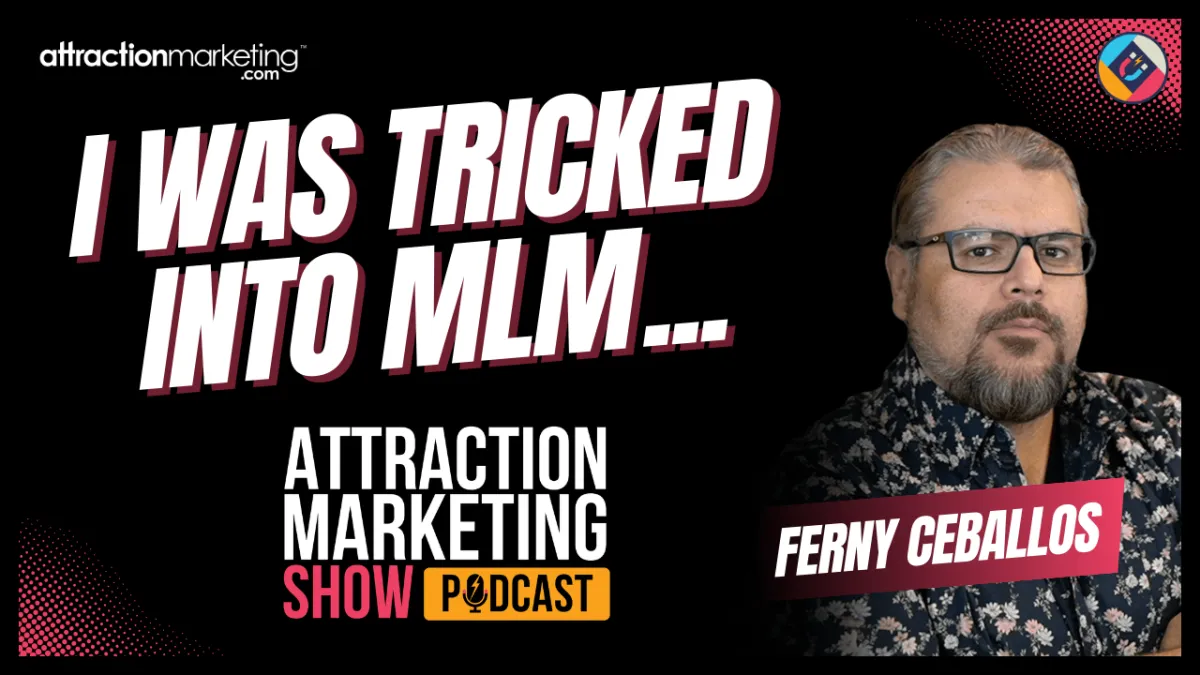
Tricked Into My First MLM Meeting | Episode 1, Part 1
Season 1, Episode 1, Part 1 | The Attraction Marketing Show
What does it actually take to build a network marketing business you don't hate?
Not the version where you're texting old college friends at 11pm. Not the version where you're getting tricked into hotel meetings or buying leads that go nowhere. The version where people actually come to you — curious, qualified, ready.
In the very first episode of the Attraction Marketing Show, host JT DeBolt sits down with Ferny Ceballos — CEO of AttractionMarketing.com, co-founder of the digital recruiting movement, and the man widely known as the "Godfather of Attraction Marketing" — for a conversation that is equal parts origin story, business masterclass, and ruthlessly honest take on what the industry gets wrong.
This is Part 1. It covers Ferny's full backstory — from the MIT engineering degree he didn't want, to the meeting he got tricked into, to the nine months he spent failing the traditional way, to the discovery that changed everything, to how he ended up owning the very company he once joined as a broke, desperate student.
If any part of that sounds familiar, keep reading.
From MIT to the Aerospace Industry — and Completely Unfulfilled
Ferny Ceballos had done everything right. Graduated from MIT with a degree in electrical engineering and computer science. Landed a job working on classified government space programs for a defense contractor in Los Angeles.
And within two days, he knew he didn't want to do it for the rest of his life.
"I didn't have control over what projects I worked on. A lot of it was paperwork. The commute was brutal. There was nothing about that situation that I loved."
So he went back to USC for grad school, hoping the answer would present itself. A year and a half in, a classmate reached out on AOL Instant Messenger and invited him to what sounded like a startup collaboration. Engineers from Caltech, Harvey Mudd, the top schools in California. Clearly something real was happening.
Then someone started drawing circles on a giant Post-it board.
Ferny knew immediately. He sat through it politely, asked the obligatory "is this a pyramid thing?" question — just to say it out loud — and left. Then he ghosted his sponsor for two weeks.
But something kept pulling at him. Going back to school was just digging him deeper into a path he didn't want. And if there was even a sliver of truth in what they were saying about building a business and creating freedom...
He called back. And he got started.
Nine Months of Doing Everything Wrong
For nine months, Ferny did exactly what he was told. Home parties. One-on-ones at Starbucks. Cold prospecting. He recruited 17 people.
And then his entire team quit.
What frustrated him most wasn't the failure — it was the absence of real training. He kept being told what to do, but never how to do it. "It's not selling, it's sharing" was the party line. Get more people to meetings. Don't overthink it.
As someone who had trained for years to master a specific profession, that made zero sense. You wouldn't tell a doctor to just "share medicine" without any training on how to actually practice medicine. Why was this different?
"I was being asked to do things that were deceptive — hiding as much information as possible, getting people to a meeting with minimal context. That's what I was taught."
He tried to figure it out as best he could. But the cracks were showing. His team had evaporated. He was burning out. And then — almost by accident — he clicked on a Google ad.
Magnetic Sponsoring and the Discovery That Changed Everything
The ad headline said something like: "This will work for you even if you're the last guy still stuck in [your company name]."
Ferny was, in fact, feeling exactly like that guy.
He clicked. He opted in. He bought the book — Magnetic Sponsoring, written by Mike Dillard. And for the first time since joining network marketing, someone was speaking to him like an adult. Here are the skill sets you need. Here's how to think about building a business. Here are the inputs and outputs of a real system.
"It was the first time I heard about treating your network marketing business as a profession. Not just something you do — a skill set you develop and master."
The core idea was a revelation: instead of chasing people, you build systems that attract qualified prospects to you. You create content. You run traffic. You track what's working. It was almost scientific. For an MIT engineer, it finally made sense.
Six weeks after implementing what he'd learned, Ferny was generating leads online and making around $1,000 a month. Small, but it was proof. It was working. And he was just getting started with this new approach to building a network marketing business online.
Falling Into the Information Junkie Trap
But progress stalled. Ferny had consumed everything he could find — Google AdWords courses, YouTube growth strategies, MySpace, all of it. He'd spent roughly $90,000 on programs and courses, most of it on credit cards.
He knew a lot. He was still stuck at $1,000 a month.
At a small digital marketing conference, he had a conversation with a six-figure earner and realized he was coaching the guy — teaching him things the guy didn't know. Later that same weekend, someone at dinner looked him dead in the eye and said:
"You seem to know a lot about this. So why aren't you successful at it?"
That hit. And the honest answer was: he was afraid. Afraid of making mistakes. Risk-averse by nature, from his engineering training where a wrong calculation means a satellite falls out of the sky. He was consuming information instead of acting on it. He knew what to do. He just couldn't get out of his own way.
What he needed wasn't more information. He needed a mentor.
The $60,000 Bet That Paid Off
Around that time, a webinar went live from someone named John Keel — a top earner who understood both the internet marketing world and network marketing. He was offering a year-long mentorship program: monthly calls, quarterly workshops, and one full day at his home office. The price: $60,000.
Ferny was already $90,000 in debt. He was going through foreclosure. He was living with his mom.
"The question wasn't should we do this. It was: how do we make this happen?"
He and his business partner put $5,000 on a business credit card and got on a 12-month payment plan. For the next year, they worked to pay down that card every single month so they could make the next payment.
What changed wasn't the information — he already had that. What changed was the accountability. The structure. The consistent presence of a mentor he trusted who could say "you're on the right track, keep going."
The second-guessing faded. The fear of mistakes faded. He started moving faster.
Nine months in, they had their first multiple six-figure month. As in, more than half a million dollars in a single month.
"It was always in me. I just needed the structure, the accountability, and someone going: yeah, keep going."
Why Mentorship Works — The MIT Framework
This is where the conversation gets interesting, because Ferny doesn't just describe his mentorship experience — he unpacks why it worked.
He draws a direct line between three environments where he thrived: MIT, martial arts, and the $60,000 mentorship program. The common thread in all three wasn't talent. It was structure.
MIT, he explained, uses the same textbooks as every other university. Physics is physics. What makes it different is the pressure — plus the support structure underneath it. Small group sessions, one-on-ones, office hours, mental health resources. "They put on the pressure, but they don't let you fall out."
And the environment itself creates belief. You are surrounded by people who tell you constantly that you are capable of world-changing work. That belief becomes real.
The mentorship program worked the same way. Not because of the information. Because of the feedback loop. Because of having someone look at what you're doing and say: that's right, keep going. Or: try this instead.
"Most people who want it badly enough, if they're put in the right environment with the right mentor — they can thrive. That's the majority of people who create real success."
From Student to the No Excuses Summit
As Ferny grew, his relationship with the founders of Magnetic Sponsoring grew with him. He started contributing in their online community — a forum-based social network called Better Networker — answering questions, publishing content, giving full credit to Mike Dillard and Tim Erway for everything he'd learned.
That transparency opened doors. They noticed him. Eventually made him a moderator, then a partner in running the community.
Then in 2010, Ferny organized something that had never been done before: an in-person event for network marketers building online. He announced it and sold 1,000 tickets in two months to a live event at the Venetian in Las Vegas — with 15 speakers including Mike Dillard, Tim Erway, Todd Falcone, and Mark Hoverson.
Two months from idea to 1,000 people in Vegas.
"This is the blessing of being completely ignorant about what it takes to do certain things. We didn't know. So we just did it anyway."
The No Excuses Summit ran for ten years. From it came smaller intimate workshops, year-long mentorship programs, and eventually the full infrastructure of what AttractionMarketing.com would become.
Ray Higdon attended the very first event as a nobody. He was a speaker at the next one.
Becoming Co-Founder of the Company That Changed His Life
Around 2014, Mike Dillard decided to step away from the network marketing space entirely. Tim Erway bought him out of Magnetic Sponsoring — and then called Ferny.
"Would you like to partner — basically take Mike's place, and be the face of this company?"
It was a dream Ferny had quietly held for years. Not to own Magnetic Sponsoring specifically, but to build something like it. A company dedicated to teaching network marketers how to build the right way.
He merged his training company and events business with Tim's. They rebranded. Eventually becoming what it is today: AttractionMarketing.com.
The student had become the co-founder. The guy who got tricked into a meeting in 2005 now ran the very organization he once joined as a broke, debt-ridden student fighting foreclosure.
Twenty-five years of proof that you can build a network marketing business online — and counting.
Building the Mentorship Machine — and Why Their Model Is Different
When Ferny and Tim officially launched AttractionMarketing.com's mentorship programs in 2014, they built them from the ground up based on everything that had actually worked — the MIT framework, the martial arts model, the $60,000 mentorship, and the lessons from years of live workshops.
The fundamental belief: people don't fail because they lack information. They fail because they lack a real feedback loop.
"Most network marketing companies tell people what to do, but not how to do it," Ferny explained. "We teach skills. We treat people like adults. And we have a structured curriculum with real accountability."
But what truly separates their model from everyone else in the space is this: their most successful students become their faculty.
TikTok specialists. Instagram Reels coaches. Facebook strategy experts. Automation and funnel builders. Duplication systems experts. Every one of them a former student who built their business, made it, and came back to train others doing the same.
"No single person can be an expert in all of it. Some companies try to do that — one guru who knows everything. That's ridiculous. We built a team of specialists."
Some of those former students are now exclusively internal — they don't build network marketing businesses anymore, they mentor inside AttractionMarketing.com full-time. Others still build while also coaching inside the programs. Some are brand partners who publicly endorse the company and mentor leaders on the back end.
The result is a mentorship ecosystem that can genuinely adapt to any person, at any level, building in any style — introvert or extrovert, free traffic or paid ads, brand new or already leading a team of thousands.
─────────────────────────────────
Ready to Put This Into Practice? Here's Your Next Step.
This episode was made for network marketers who know there's a better way to build — and are ready to find it.
The Digital Recruiting Bootcamp is a free step-by-step training on how to attract qualified prospects online, enroll with confidence, and build a team that actually duplicates.
No cold messaging. No home parties. No cringe.
👉 Click here to get free access and get started today.
─────────────────────────────────
That's where Part 1 leaves off.
In Part 2, the conversation shifts from origin story to current reality —what the industry is facing right now, why most network marketers are one company shutdown away from losing everything, what it actually means to treat your business like a real business, and what Ferny predicts for the next decade of network marketing.
It also includes some of the most honest rapid-fire answers you'll hear from anyone in this industry — including the cringe tactic that still haunts him, the one myth he'd erase forever, and three books every serious network marketer should have on their shelf.
Continue reading: Episode 1, Part 2 →
─────────────────────────────────
And if you haven't subscribed to The Attraction Marketing Show yet, now's the time.
New episodes drop every week —real conversations with the people who built this movement.