
episodes
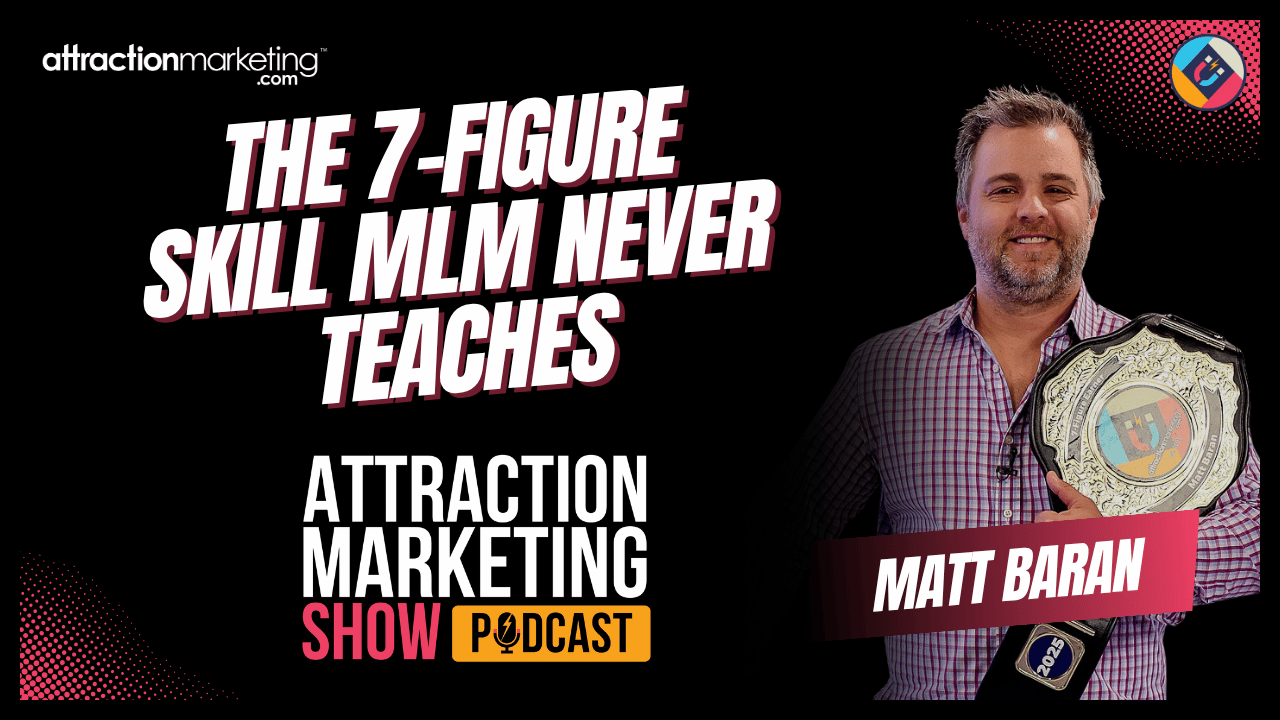
Matt Baran: The 7-Figure Skill MLM Never Teaches | Episode 13
Episode 13 | The Attraction Marketing Show
Matt Baran never built a downline.
He never ran a team, never hit a rank, never attended a recognition ceremony. He came into the AttractionMarketing.com world as an internet marketer who happened to find Ferny at No Excuses Summit — and what he absorbed from years of direct response training in that community turned into a seven-figure affiliate marketing business he built almost entirely on YouTube.
He's proof that the skills being taught in the network marketing education space are not network marketing skills. They're entrepreneurship skills. And they transfer.
In Episode 13 of the Attraction Marketing Show, host Andrew from AttractionMarketing.com sits down with Matt for one of the most technically rich and practically useful conversations the show has produced. They cover paid traffic, the psychology of hooks, target market research with AI, the one word Tim Erway wrote on a sign that Matt still keeps above his computer, and why the skill MLM almost never teaches is the one that determines everything.
The MBA Who Got to Six Figures and Immediately Hated It
Matt did everything the right way. College. MBA. Climbed the corporate ladder at an insurance brokerage. Landed the highly sought-after six-figure job that was supposed to mean he'd made it.
Two weeks in, he knew he'd made a terrible mistake.
"I just remembered how miserable I was. I thought that should've been like the heavens parting — this is it, I finally made it. And I actually hated it. I thought, wow, this is what the next 30 years of my life is gonna look like."
He went home and typed how to make money online into Google. Found his way to the Warrior Forum. Found his way to No Excuses Summit. Found Ferny. Signed up for whatever program was available at the time. And started learning traffic.
Not network marketing. Traffic.
He was always more interested in the mechanics of getting someone to click than in building a downline. The idea that you could place an ad, use the right words, and have a complete stranger hand you money — that was the thing that got him out of bed.
"I've always been a huge introvert. I was deathly afraid of having to do sales in person — the pushy salesman thing, I hated it. The idea that you could place an ad and get someone to hand you money without a single face-to-face conversation? That really, really appealed to me."
He spent years running traffic for AttractionMarketing.com directly — Facebook ads, pay-per-view, the various platforms that came and went — while also mentoring students and sitting in on weekend workshops where TJ and Ferny would repeat direct response principles so many times they became second nature.
That repetition, he says now, was the real education.
$200 to $100,000 — The YouTube Breakthrough Nobody Saw Coming
By 2019, Matt was ready for a change. He left AttractionMarketing.com and went back into the insurance industry — this time on the marketing side, applying his digital skills to corporate campaigns.
The culture shock was immediate and instructive. His primary KPI was impressions. Not leads. Not sales. Impressions. As long as ads ran, the job was done.
"That just shows you how far behind corporate-level marketing is. Impressions. As long as the ads are running, you did your job. I get my 3% raise every year. That's it."
He spent two years there, went through the pandemic, and gradually started to feel like that entrepreneurial chapter of his life was over. He'd given up on being the face, the teacher, the guru — he'd tried it and it never stuck.
Then in late 2021 he got sucked into a webinar about using AI voices and B-roll footage to run YouTube ads for affiliate products. It sounded low-tech, almost silly. He tried it anyway.
Two months of burning money. Then:
"Day one: I spent $200 and made $600. Day two: I spent $400 and made $1,000. Day three: I spent $800 and made $3,500. I didn't touch anything. I just refreshed my stats all day watching the money come in. I'd never seen anything like that before."
Within thirty days he had his first $100,000 profit month. Not revenue — profit.
He dove headfirst into YouTube ads and never looked back. Today he runs a team of media buyers and video editors, promotes affiliate offers across multiple niches from supplements to home services, and generates seven figures annually from skills he learned sitting in the back of direct response workshops a decade ago.
The network marketing company part never mattered. The direct response marketing education did.
The One Word Above His Computer
When Andrew asks Matt what the single most important mindset lesson has been across his entire career, his answer is immediate. He doesn't pause.
He points to a yellow sign above his computer.
"The one piece of advice Tim Erway gave me when I first started back in 2013: be resourceful. That alone has allowed me to overcome so many obstacles. That has been the backbone of my success — more than any tactic, any platform, any campaign."
He describes what resourcefulness actually looks like in practice when a campaign stops working — which happens constantly in paid traffic.
Google updates its algorithm. Traffic costs jump 35% overnight. Campaigns that were profitable last week are bleeding money this week. The emotional response is to panic, to catastrophize, to declare that YouTube doesn't work or the platform is dead.
Matt's response is systematic.
"I look at all my stats. I have spreadsheets tracking everything. I compare what it looks like now to what it looked like when things were working. I pinpoint where I'm actually losing money. Then I make a list of every possible thing I can do — I've got about 100 items now. And I just work through it. That didn't work, next one. That didn't work, next one. Remove the emotion. Work the list."
He applies the same framework to non-traffic problems. Technical issues he can't solve get twenty minutes of genuine effort before he asks for help. Nine times out of ten, the twenty minutes is enough.
When he hired a productivity coach, the coach introduced him to using ChatGPT as a consultant — not for content, but for getting unstuck. Ask it the question. Have the conversation. Even if the AI doesn't give the perfect answer, it breaks the mental paralysis and gets the gears moving.
"You're not sitting there going, I don't know what to do, this isn't working, stuck in your own head. You have that conversation with the smart robot and it gets you unstuck. At the very least it points you in the right direction. That alone is worth everything."
Direct Response Is the Skill MLM Never Teaches — But Should
The through-line in Matt's career — from pay-per-view ads in 2013 to YouTube dominance in 2024 — is not platform expertise. Platforms change. The skill underneath every platform he's ever used is the same.
Direct response marketing. Specifically: the ability to interrupt someone's attention, hold it for five seconds, and make them want to keep watching.
"On YouTube you've got five seconds before someone hits the skip button. Five seconds. I call it the 95/5 — that five seconds is 95% of the work. If they hit skip, they're gone. You have to get their attention, make them curious, and pull them into the next ten seconds. And then the next. There can be zero filler. Every single word has to be doing a job."
He learned this not from a YouTube ads course. He learned it from years of sitting in the back of AttractionMarketing.com workshops listening to TJ and Ferny repeat the same direct response principles — hooks, calls to action, speaking to the pain, creating the trance.
The platform was Facebook then. Today it's YouTube. Tomorrow it'll be something else.
The principles don't change.
"All that stuff I learned long ago — the reason why I say the things I say, the hooks, the calls to action, the techniques — that's all from years of studying this at those workshops. Those skills allowed me to get to seven figures even though I never built a single downline."
His argument, and it's hard to refute: the education being delivered inside AttractionMarketing.com isn't really network marketing education. It's entrepreneurship education with network marketing as the context. The skills are portable. The results are scalable. And anyone who absorbs them and applies them — in any market, on any platform — has a genuine advantage.
Target Market Is Everything — And AI Has Made the Research Effortless
Andrew asks Matt about target market — the exercise AttractionMarketing.com runs every student through, and then runs them through again, and then again, because most people don't go deep enough the first time.
Matt's answer is blunt: it's the most important thing. And also the thing people consistently underestimate.
"Once you've got somebody right here — really hit them in that core — it's like you can do a lot of wrong things and still get a customer. But if you miss on target market, if you get the wrong person, you can do everything else perfectly and still get nothing."
His process for target market research now is entirely AI-driven. He uses ChatGPT to generate journal-style entries from the perspective of his ideal prospect — their pain, their language, their internal monologue, their specific fears and desires. The AI gets about 95% of the way there, he says. It's the most efficient tool he's ever used for this work.
Then he uses those pain points in his hooks. Not as subtle references — as direct, specific callouts designed to stop the scroll and make the right person think the ad was written about them personally.
"When someone watches your ad and thinks, oh my God, they're talking to me — that's when you've got them. That's the trance. That's what all the target market work is building toward. You're trying to create that moment where they feel completely seen. And when they feel seen, they listen. And when they listen, they act."
He shares the contrast: he once signed up for a newsletter from an ad that was clearly well-written, read multiple emails, and still couldn't figure out who the advertiser was trying to talk to. Intelligent copy in search of a target market that was never identified. Good mechanics, wrong foundation.
The lesson: target market clarity isn't a nice-to-have. It's the thing that makes everything else work.
The Skills Are the Point — Not the Vehicle
Near the end of the episode, Matt lands on the idea that ties everything together — and it's the same idea that runs through every conversation on this show, from Ferny's origin story to Tim's philosophy to every guest who rebuilt after a company shutdown.
The skills you build are the asset. The company, the platform, the product, the opportunity — those are vehicles. Vehicles change. The skill set travels with you.
"Even if network marketing isn't your thing, I'm proof that these skills can be used for a lot of stuff. Seven figures in affiliate marketing. Two niches that have nothing to do with each other. All built on the same direct response foundation. These are just entrepreneurial skills. They're not MLM skills. They're entrepreneurial skills."
He's not dismissing network marketing. He's clarifying what's actually valuable about the education that surrounds it.
The person who learns to write a hook, understand their prospect's pain, speak in the language their audience actually uses, and test and iterate until something converts — that person can build something on any platform, in any market, with any offer.
That's what AttractionMarketing.com has been teaching for over two decades. Matt Baran is just one example of where it can go when someone actually applies it.
─────────────────────────────────
Ready to Put This Into Practice? Here's Your Next Step.
This episode was made for network marketers who know there's a better way to build —and are ready to find it.
The Digital Recruiting Bootcamp is a free step-by-step training on how to attract qualified prospects online, enroll with confidence, and build a team that actually duplicates.
No cold messaging. No home parties. No cringe.
─────────────────────────────────
And if you haven't subscribed to The Attraction Marketing Show yet, now's the time.
New episodes drop every week —real conversations with the people who built this movement.

Categories
Attract 3-7 New Customers & Team Members per Week Without Prospecting a Single Person
...and never have to spam strangers scripted messages
OR bug your friends and family ever again!
watch & listen
wherever podcast live









Presented By

navigation
CONTACT US
AttractionMarketing.com
274 E Eau Gallie Blvd Ste 375
Indian Harbour Beach, Fl 32937
CONNECT WITH US


Copyright 2026 AttractionMarketing.com, LLC. | All Rights Reserved.