
episodes
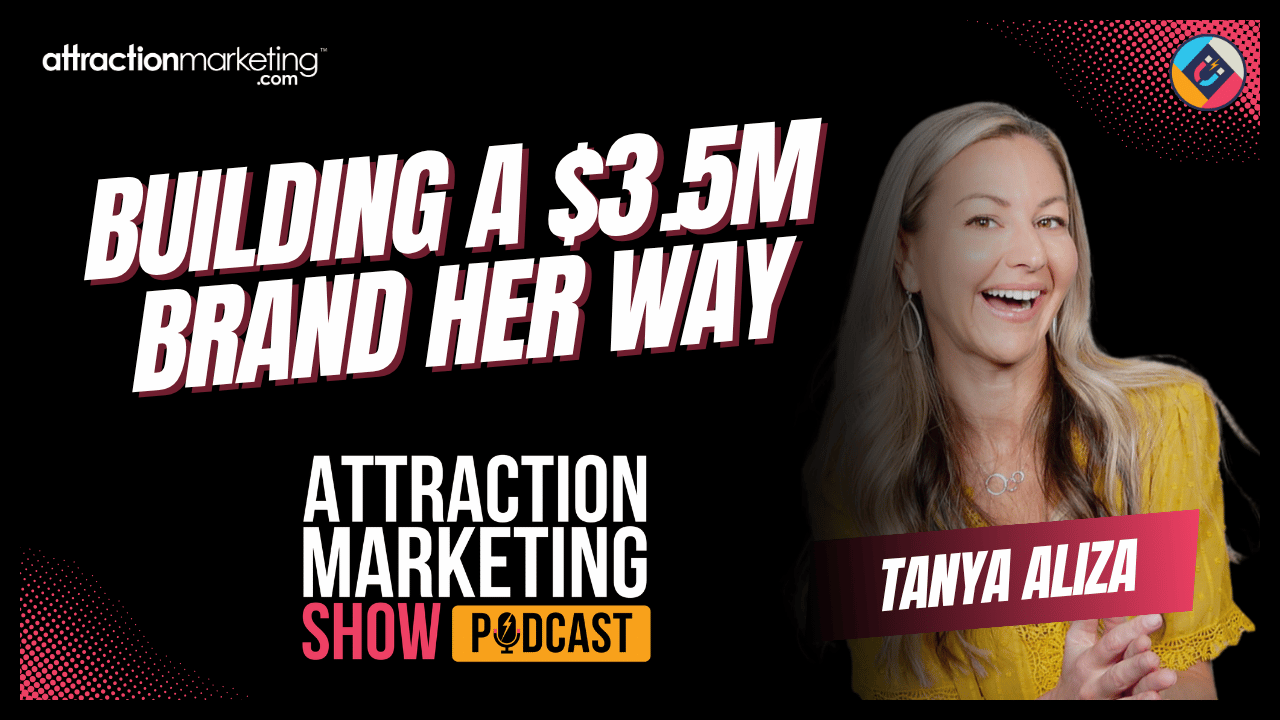
Tanya Aliza: The Black Sheep Who Built a $3.5M Brand Her Way | Episode 15
Episode 15 | The Attraction Marketing Show
Tanya Aliza sat through a network marketing presentation with her arms crossed and thought it was the cheesiest thing she'd ever seen.
Then they showed her the income graph. She asked to see proof. They opened their back office. She signed up on the spot and bought the easel.
That was 2009. What followed was four years of learning, a move to Costa Rica with a laptop and a surfboard, a call to a stranger named Tricia from Texas that changed everything, a Thursday Skype training that eventually became a course, and a single headline rewrite that turned a failed product into a $3.5 million brand.
She did it her way. As the black sheep. Without following the plan. And the team that once stopped inviting her onstage for not following the system eventually came around — because her results were impossible to ignore.
In Episode 15 of the Attraction Marketing Show, host Andrew from AttractionMarketing.com sits down with Tanya for a wide-ranging conversation on her origin story, the fear that pushed her to call leads, why her first course flopped and what one message change did to fix it, the compound effect of content, and what she's doing with AI right now that's quietly changing everything.
Arms Crossed on a Couch — and Completely Sold by the Income Graph
Tanya was a waitress turned finance industry professional working twelve-hour days, six days a week, making good money and spending none of it. A YouTube video of a family who'd left corporate life to travel the world with their daughter cracked something open. She started reading The 4-Hour Workweek. Rich Dad Poor Dad. And then a girlfriend invited her to a house meeting.
She went to be supportive. She sat with her arms crossed the whole presentation. She thought it was ridiculously cheesy.
"Then they got to the part about money. And I am a hustler. I love what money can actually do — the freedom it provides, the ability to help people. And I looked at that income graph and I thought: this is over double what I make. I don't believe them."
So she walked up afterward and asked them to prove it. They opened the back office and showed her their last week's pay.
She was in. Immediately. Bought everything. Got the easel. Started lugging her flip chart from house to house doing presentations — until she figured out you could do it on video.
She didn't crush it right away. For a while she was the one nobody in her circle took seriously, because she was the only one with a real career. That gave her a small edge, but she wasn't building a network marketing business online yet. She was treating it like a side gig.
Then in 2010, her stepfather had a stroke and passed. She took almost a month off to be with family. And she noticed something that changed the direction of everything.
"I wasn't going to work. But I had a little bit of money coming in from network marketing, and I was like — this is so cool. I can take time off with my family and not worry about money coming in. I had never experienced residual income before. And he passed at 61. Life is way too short to be stuck doing something that doesn't bring you joy."
She went all in.
Costa Rica, a Laptop, and a Woman Named Tricia From Texas
Working twelve hours a day, six days a week left no time to prospect. So she went online — trying to figure out how to get in front of people who were already searching for what her products could do.
She found Frank Kern. Learned copywriting and SEO. Started building opt-in forms so green she didn't know where people went after they submitted their name and email. She was so afraid of breaking something she called her mentor before putting in her own name to test it.
A year of building with no visible results. Then her business partner at the finance job got let go, and Tanya was asked to train the owner's eighteen-year-old niece for that position and split commissions fifty-fifty with someone who didn't know how to sell.
She gave her notice. Moved to Costa Rica with a friend who was opening a restaurant. Lasted two days in the restaurant. Pulled out her laptop and surfboard and started building.
She had a thousand leads and zero sales. Then she got on a webinar where someone told her the thing she least wanted to hear.
"Call your leads. And I'm like — call leads? I don't wanna talk to my leads. I just want people to sign up. But she said if someone leaves you their phone number and you're not calling them, you're doing them a disservice. They want you to help them."
She picked up the Skype headset. The first person she called was Tricia from Texas.
"She answered and said, 'The Tanya Aliza? Are you sure?' Like I was a celebrity. And I'm thinking — what are you talking about? I'm a nobody. But she had been reading my blog, watching my little YouTube videos, downloading my freebies. She was treating me like I was famous. And I realized: this is completely different from calling cold leads who don't know you. I could call leads all day with conversations like this."
She started dialing two hours a day. She got obsessed with closing. Within about four years of consistent building, she had a quality problem: she was enrolling so many people she didn't have time to train them all.
The Black Sheep Who Produced All the Numbers
While Tanya was building online — blogging, creating YouTube videos, generating leads through a system her own company didn't endorse — her upline wasn't celebrating. They stopped inviting her onstage to share her story because they didn't want their team to deviate from the plan.
She kept building anyway.
When the numbers got too big to ignore, her upline called.
"Her name was Judy, and she called me and said, 'What are you doing?' I said — instead of me teaching you, can you just help me with what I'm doing? So we created a partnership where I'd enroll and she'd train. I bring them in. She trains them on how to build. That worked really, really well for a long time."
This is how unconventional paths eventually get validated: not by argument, but by results. The same company that kept her off stages for not following the plan watched her produce numbers the plan couldn't explain. The team came around.
She had already moved on to the next problem anyway. Because once you can consistently generate leads and close them, the question becomes: how do you train that many people without burning out the people who train them?
The Thursday Skype Call That Became a $3.5M Brand
People started asking Tanya how she was getting leads. Instead of explaining it individually over and over, she started hosting a free Thursday training on Skype — before webinar software existed — and just showing her community what she was doing.
A business coach told her she should charge for it. When people pay, they pay attention.
She had no idea how to take a credit card online. She figured it out anyway. Spent months creating her first course. Put it up with no launch strategy — just a sales page going live — and waited.
One sale came in the next day.
"I worked on this thing for months. I thought everybody would want it. No one wanted branding. Back then, branding was something you did to cows. My messaging was completely off."
She hired a coach to look at it. The lesson that changed everything: people don't want the thing. They want the transformation.
She kept the course. Changed the hook.
"The new headline was: how I enroll two to five new teammates every single week like clockwork without bugging my friends and family. That course sold $3.5 million. Same course. Same content. Different message. That's it."
The product became the foundation of a coaching business she never planned to build. Students who went through the program asked to work with her directly. They joined her network marketing team. They bought affiliate products she recommended. One piece of real value fed everything else.
That's what building a brand actually produces when done right — an ecosystem where each piece amplifies the others, and nothing requires you to chase anyone.
The Compounding Content Machine — and What a Year Off Revealed
Tanya eventually stepped back from network marketing to build Digital Creator Studio — a company built around helping entrepreneurs create content ecosystems of their own. She took a full year off from posting, recording, and creating.
During that year, her list kept generating three to five thousand leads a month.
"Every piece of high-value content you put out is like a fishing line in the water. The longer you do it, the more lines you have. Eventually you have a net. And as long as your content leads with the right message to the right audience with the right lead offer — you can never turn the lead flow off. It's the coolest thing."
She's direct about how long the build takes: it's longer than most people want to hear. But she's also clear that the tools available today — Reels, Lives, AI — dramatically accelerate the timeline compared to what she was working with in 2010.
Her current strategy for every high-value piece of content: pair it with a Reel that asks followers to comment a keyword to get the piece sent to them. Even accounts with small followings are generating floods of leads this way.
"Comment 256 below and I'll send you my new piece of content that gives you this — and insert the benefit. Those are working like gangbusters right now even with small accounts. The opportunity today is so much greater than it was before."
Costly Signaling — Why Consistency Beats Results
Andrew introduces a concept in this episode that Tanya immediately connects with: costly signaling.
The idea is simple but underappreciated. The more consistently you show up — week after week, episode after episode, post after post — the more legitimate you become in the eyes of your audience. Not because you've earned a credential, but because sustained effort signals real commitment.
"If you're launching a business and don't have a track record yet, let's see if you stick with that thing for three months, six months, nine months. People notice that. They think — wow, she's really invested in this. Even if your results are zero, just the fact that you're doing it, people are going to start following you."
Tanya lives this in her own audience. People sit on her list for months. They watch every Thursday training. They wait to see if she shows up again next week. And when she does — consistently, reliably, without drama — they trust her. That trust is what makes the eventual sale feel like a natural next step rather than a pitch.
She doesn't frame this as patience advice. She frames it as a business principle: show up like a real business and you will be treated like one.
Lead Magnets, LoRAs, and the AI Edge Most People Are Missing
Tanya was one of the early practitioners of episode-paired lead magnets — creating a new, relevant freebie for each piece of content she released, inspired by watching Amy Porterfield stop her treadmill mid-workout to opt in for a freebie on a podcast episode.
"If I'm doing this — stopping everything I'm doing to opt in for her freebie — I need to do this in my business so other people do this with me."
Today she's evolved the model. Plain Google Docs. AI prompt swipe files. Constantly updated resources that don't require Canva skills or design polish. The more raw and specific the lead magnet, the more it converts — because specificity signals that you understand the exact problem your audience is sitting with right now.
On the AI side, she's experimenting with LoRAs — a process where you upload high-quality images of yourself and train an AI model to generate realistic photos that look like you in any scenario. Her use case: YouTube thumbnails. The goal is to eliminate the mini photo shoot required every time she needs a new thumbnail image.
"Sometimes you cannot tell the difference between me and the AI. And for thumbnails especially — if I could just prompt an image of myself instead of doing a whole shoot, that's a significant time save at scale."
She's honest that she hasn't fully cracked it yet — image quality and realism are still improving — but she's watching the technology closely and testing actively. The broader point she makes about AI is the same one that runs through this entire show: the people who will benefit most are the ones already doing the work, who use AI to make that work faster rather than to replace the thinking behind it.
She uses it to write, rewrite, and edit. For someone who suspects she's slightly dyslexic and reads her own writing out of order, having an AI clean up structure and sequence is one of the highest-leverage uses of the tool she's found.
The Woman Who Got Kicked Off the Stage for Not Following the Plan
The most telling detail in Tanya's entire story isn't the $3.5 million course. It isn't the 3,000 to 5,000 leads a month she generates without posting. It isn't the Thursday Skype calls or the Costa Rica year or the flip chart she lugged to houses.
It's that her company once stopped inviting her onstage for building online — and later, the same leaders who dismissed her came around when the numbers were undeniable.
She didn't need their permission then. She doesn't reference it now as a grievance. It's just a data point: the right approach wins eventually, regardless of whether anyone endorses it at the start.
"I was the black sheep of the team, but I started to produce all these numbers. And then they started to come around a little bit. The method wasn't wrong. It was just early."
That's what being ahead of the curve actually looks like in practice. Not comfortable. Not celebrated. Often actively discouraged. And worth it anyway.
Tanya Aliza built a $3.5 million brand her way — from a cheesy couch presentation in 2009 to a compounding content machine that generates leads while she sleeps, takes time off, and builds the next thing.
The plan nobody endorsed turned out to be the plan that worked.
─────────────────────────────────
Ready to Put This Into Practice? Here's Your Next Step.
This episode was made for network marketers who know there's a better way to build —and are ready to find it.
The Digital Recruiting Bootcamp is a free step-by-step training on how to attract qualified prospects online, enroll with confidence, and build a team that actually duplicates.
No cold messaging. No home parties. No cringe.

─────────────────────────────────
And if you haven't subscribed to The Attraction Marketing Show yet, now's the time.
New episodes drop every week —real conversations with the people who built this movement.

Categories
Attract 3-7 New Customers & Team Members per Week Without Prospecting a Single Person
...and never have to spam strangers scripted messages
OR bug your friends and family ever again!
watch & listen
wherever podcast live









Presented By

navigation
CONTACT US
AttractionMarketing.com
274 E Eau Gallie Blvd Ste 375
Indian Harbour Beach, Fl 32937
CONNECT WITH US


Copyright 2026 AttractionMarketing.com, LLC. | All Rights Reserved.